Sunday, January 9, 2022
What If Deconstruction and Difference Were Divine
Wednesday, November 25, 2015
What Not to Talk About at Thanksgiving
-----
A Great Placemat from www.showingupforracialjustice.org
Monday, August 31, 2015
Be Opened: Lectionary Reflections for Back to School Youth and the Rest of Us, too.
And she was open to a miracle and resurrection possibilities. Her only question, would Jesus be open as well?
“You abandon the commandment of God and hold to human tradition…You have a fine way of rejecting the commandment of God in order to keep your tradition” (Mark 7:8-9).
Be opened by forgiveness.
------
Thanks to fellow Presby, Mihee Kim-Kort, for featuring the litany in her Podcast, "This Everyday Holy":
http://thiseverydayholy.com/2015/09/06/episode-11-putting-faith-to-work/
A great Podcast that brilliantly engages the story of the Syrophoenician woman:
LectioCast: Entrusting Ourselves to Abundance and Generosity
http://homebrewedchristianity.com/2015/08/31/entrusting-ourselves-to-abundance-and-generosity-lectiocast/
See also a recent reflection from Jill Duffield of The Presbyterian Outlook:
http://myemail.constantcontact.com/Looking-into-the-Lectionary--23rd-Sunday-of-Ordinary-Time--September-6-.html?soid=1102135377571&aid=eJyHvf3y5GI
Thursday, March 27, 2014
World Vision, Gay Marriage, and Trinitarian Theology
In the name of the Father, Son, and Marriage Between a Man and a Woman, Amen?
While I have been known to swim within the gray waters when it comes to the same-sex marriage debate, one thing I can say with confidence: neither gay nor straight marriage are central to Trinitarian theology.
That said, when World Vision decided to welcome and employ those who were in same-sex marriages, I was impressed by a large Christian NGO's willingness to move beyond the debate and work to rally around Jesus' invitation for peacemaking and advocacy on behalf of our poorest and hungriest neighbors. There were brilliant and beautiful articles written in efforts to underscore how it was possible for an Evangelical Christian organization to move past partisan divides and differences in theological opinions as we together labor on behalf of our most vulnerable and malnourished brothers and sisters, many who are children.
"It's been heartbreaking to watch this issue rip through the church," he said. "It's tearing churches apart, tearing denominations apart, tearing Christian colleges apart, and even tearing families apart. Our board felt we cannot jump into the fight on one side or another on this issue. We've got to focus on our mission. We are determined to find unity in our diversity."
Richard Stearns, President of World Vision, U.S.A (cited in interview by Christianity Today)
World Vision was taking an ethical, financial, and pragmatic risk. That is, until they decided they would not.
One of the most well-known Christian relief organizations recanted after being confronted by numerous individual and denominational donors who expressed distain for their supposed open and affirming stance. As a number of bloggers, journalists, and grassroots advocates rightly expressed, the poor and hungry became pawns within yet another spite-filled and slanderous debate. Conservatives and progressives are both at fault.
I cannot say I am surprised by World Vision's flip-flopping, but I am grieved by how quickly they caved in response to financial backers and child sponsors who cannot handle the employment of those whose sexual orientation they disapprove.
Let's be clear, World Vision is doing incredible things all around the globe and I remain grateful for their witness to the good news of Jesus.
Nonetheless, World Vision's rationale for their 180° belly flop is sadly flawed and simply wrong.
"What we are affirming today is there are certain beliefs that are so core to our Trinitarian faith that we must take a strong stand on those beliefs...We cannot defer to a small minority of churches and denominations that have taken a different position."
Richard Stearns, President of World Vision, USA (48 hours later in another Christianty Today interview)
Definition of marriage as core to orthodox, Trinitarian confessions is an unfortunate and illogical theological union by those who should know far better. Trinitarian theology is about God and how God relates to the world: Father, Son, and Holy Spirit.
Yes, same-sex marriage is an important, relevant, even a theological conversation for both church and state, individuals and denominations. No, gay or straight marriages are not core matters of what makes for uniquely Trinitarian theology.
Despite belief to the contrary, Scripture does not paint a black and white portrait of marriage. One does not need to read far into the pages of ancient narratives to discover the plural nature of marriages by our biblical heroes, the leniency related to how far up the family tree it was permitted to marry, or even what happened when your spouse passed away.
Answer: marry your husband's closest male relative. Yikes.
This is not to suggest the aforementioned as appropriate biblical models, it's simply to note marriage as a contextual witness of covenant fidelity that God has allowed to evolve over time. Moreover, when Jesus was confronted about marriage, a mind-boggling trap by antagonistic Sadducees opposed to a theology of resurrection, the Messiah's retort down-graded the institution as superfluous compared to the redefinition of relationships within God's kingdom.
"For in the resurrection they neither marry nor are given in marriage" (Matthew 22:30)
It's as though Jesus was saying, everything's about to change so quit your bickering. Your marriage debate is causing you to miss the point of the economy of God and God's coming kingdom.
When we lump the definition of marriage into our core Trinitarian confessions, we are guilty of just the same. We may need to be reminded of what the triune nature of God is really about:
"Trinitarian doctrine describes God in terms of shared life and love rather than in terms of domineering power. God loves in freedom, lives in communion, and wills creatures to live in a new community of mutual love and service. God is self-sharing, other-regarding, community-forming love."
Daniel Migliore, Faith Seeking Understanding 73*
Again, Trinitarian theology is about God and how God relates to the world: Father, Son, and Holy Spirit.
When this becomes our core, versus any stance on marriage, then and only then can we set aside both conservative and progressive positions on marriage and draw back to the forefront of our witness a unified concern and incarnated love for God's children who live on less than $2 a day.
This kind of love is to be our primary orientation.**
This kind of love is deeply Trinitarian.
This is the love of which we need to be known by the world.
Notes:
*See God as Unified and Missional Theology: Trinitarian Theology as Missional Theology
**A great read: Love Is an Orientation: Elevating the Conversation with the Gay Community by Andrew Marin
Great Pieces by Thoughtful Bloggers:
Let's Talk About What Happened Yesterday at World Vision by Tony Jones
Rachel Held Evans on World Vision
Tuesday, October 29, 2013
Doubt As Faith: What Dr. Dwight Peterson Can Teach Youth (and all of us)
When I was in high school I thought doubt was the lack of faith. Somehow I assumed very bad things were in store should I take my last breath before I was able to banish all questions about the existence of God, the Christian confession of Jesus as God in human form, and the resurrection as a real event that pointed to life beyond the grave.
I spent many sleepless nights afraid of my doubts. I feared not having enough faith. Questions about everything I had ever been taught about Christianity, the Bible, and what it meant to follow Jesus were linked to mistrust and even sin lurking at my door.
So I refused to share my doubts and instead adorned a personality and characterization as someone who had it all figured out.
I also lived in fear. Every time a doubt about ________ popped into my head, I dreaded laying my head down on the pillow that night. I feared falling asleep. I wondered if I would ever be able to sleep.
Then I met Thomas in John 20. He became my favorite disciple by far.
While this disciple is often characterized as a doubter, "Doubting Thomas," he really is the only disciple with enough audacity, courage, and faith to dig deeper into the rumors of Jesus' supposed resurrection.
Did it really happen? Seriously, I need to experience Jesus' renewed life firsthand.
And he did. Thomas would even go on to be one of the earliest and most effective missionaries of the first century and Christian history. Some suggest he brought the gospel to India. I am sure he never stopped doubting and asking the hard questions.
I also met this anonymous father in Mark 9.
The disciples, and surely the father, are frustrated by their inability to heal this man's possessed son. They had done everything Jesus had commanded and said all the right things in efforts to prevent this child from a premature death sparked by some sort of demonic, seizure-inducing possession. So when Jesus asked the father a few questions, he responds with a bit of jadedness, cynicism, and doubt, "but if you are able to do anything, have pity on us and help us!"
Jesus retorts right back, "If you are able!- All things can be done for the one who believes."
I imagine the father pausing, thinking to himself, that's the problem. You don't understand. We have tried everything. I have lived all my days in fear that this would happen and there would be nothing left. I feared my doubts would win in the end. I believed only to be disappointed.
Yet I believe, Jesus, help my unbelief!
This is quite possibly the greatest prayer recorded in Scripture. It's one I pray quite regularly. And every now and again I am given a glimpse of resurrection, like the child in Mark's gospel who is lifted from a coma, and invited to hold on hope for another day.
Yet when I have recently pondered faith and doubt, I cannot think of a more faithful witness to the good news of God's grace than one of my most beloved college professors and mentors, Dr. Dwight Peterson. Thanks to Dr. Peterson, I will never read one of my favorite gospel stories the same again. I also will never fear doubt again, or at least when I do, I will look to those who know where to find faith.
I am not sure what exactly happened between the age of Thomas and 2014 (suggestion: the Enlightenment), but faith and doubt have assumed the role of opponents. They are like opposite sides of a coin, protagonist and antagonist of a great narrative. While we live in an age of cynicism, celebrate mystery, and shove aside anything wreaking of absolute certainty, the Christian church has managed to cling to the false dichotomy: faith v. doubt.
Those who follow Jesus, especially heroes of the faith and brilliant theologians like Dr. Peterson, never doubt, right? At least they shouldn't, correct?
Yet faith needs doubt. Doubt demands faith. They are far from opposites and, when you scan the pages of both history and Scripture, one of the most common traits of those called and used by God has been, not faith, rather doubt.
"doubt is not the opposite of faith; it is one element of faith.”
Paul Tillich
I wonder if that's because doubt pushes us towards one another, reminds us that we cannot do life alone, and moves us beyond the idol of certainty that none of us will ever be able to appease?
And we were never meant to...
This does not mean quest for more doubt, it simply means doubt is not our or the church's enemy.
So as I prepare a youth talk on sharing doubts and creating sacred space for questioning, here are a few truths I cling to as a pilgrim with more than enough faithful doubt:
- There is nothing in all of creation that can separate you from the love of God in Christ, neither death nor doubt...not even doubting this to be true.
- You are not alone in your doubts; the faithful have always been doubtful.
- Doubts are not to be pursued alone. Doubts are to be confessed and adventured through alongside others and within the community of faith. Gone are the days of burning heretics at the stake, so you are safe. Well, some may talk about you in a few books/blogs by certain authors and publishers, but they are not worth reading anyway. Yet God loves them, too.
- Doubt can often lead to stronger faith and a more honest and authentic witness. But not always.
- Intellectual and academic certainty has never been the goal of discipleship. Trust, obedience, and a concern for our most vulnerable neighbors are more telling fruits of those who claim to follow Jesus.
- Faith is not the absence of doubt. And doubt is certainly not the absence of faith. They push on one another and draw God's people closer to Jesus, who is the object of our faith, subject of our hope, and Lord of all things seen and unseen.
- Doubt becomes a demon when we become so steeped in cynicism that we no longer know how to love and live with joy. Faith becomes an idol when we no longer make space for our doubts and/or the doubts of others, falsely assuming we have figured everything out and have a cpyright on truth.
- Jesus doubted. If you question, just take a look at his prayers before the crucifixion. Maybe read Psalms, which N.T. Wright calls "Jesus' prayer book."
May the God who made and loves us all, draw us ever closer to the One who lived and died for us all, and fill us all with God's Spirit.
And may the perfect love of this God cast out all fear...especially when we doubt.
A few helpful links and resources, especially for parents and youth workers:
Sticky Faith: http://stickyfaith.org/articles/i-doubt-it
Simply Youth Ministry: http://blogs.nsb.org/students/files/2013/03/Week_1_-_Doubt_and_Fear.pdf
*A great chapter in, The Theological Turn in Youth Ministry, by Andrew Root and Kenda Dean: "Doubt and Confirmation."
Related post on Confirmation: http://gregklimovitz.blogspot.com/2013/04/confirmation-questions-what-i-wonder.html
Older post by Kathy Escobar: http://kathyescobar.com/2009/09/22/doubt-amp-faith-thewild-beautiful-rid
Saturday, March 23, 2013
Rob Bell Has Come Out...with a new book. O yea, and as affirming of gay marriage, too.
Rob Bell has come out...
...with a new book.
What We Talk About When We Talk About God is more or less a culmination of Rob Bell's progressive and evolving theological convictions that eventually led to his departure from Mars Hill Bible Church. While the Evangelical world tends to stop and quiver anytime Bell speaks, or writes, or releases yet another vignette with dramatic pauses and obscure metaphors (like Oldsmobiles), I found his latest publication everything but controversial, ground-breaking, or worth Tweeting statements like "Farewell, Rob Bell" or "R.I.P. Rob Bell."
Instead, per the usual, I consider his work a welcome resource within my library of What I Try to Talk About When I Try to Talk About God with those who may not be interested in pouring their life into dense theology, philosophy and cultural exegesis.
That is, I liked it. Not as much as some of his others, but I liked it. I will recommend it, with fair warning- he talks a lot about quantum physics. But hang in there.
Bell has a knack for communicating complexity with clarity, for which I am envious and grateful. The pastor/film maker/writer/innovator/preacher/practitioner cleverly draws readers into the good news of God's love, which wins every single time.
However, what many readers often miss is that Rob is not saying anything new. Instead, books like Love Wins and What We Talk About... are rephrasings and anthologies of Christian theology that have been reduced to the margins by Evangelicals, yet embraced by mainliners and progressives for centuries. Just read his endnotes :) And if you are looking for more well-versed theology, read the primary sources instead.
Origen.
Paul Tillich.
Hans Urs von Balthasar.
Richard Rohr.
And my favorite, Karl Barth.
That's right, while some claim that Rob Bell is spitting out reverberations of Process Theology, which he certainly may, I find his work also reflective of the greatest theologian of the twentieth century- Karl Barth.
The thrust of his book hinges on God being forever for us in the person of Jesus. Better said, Jesus is God's universal YES to humanity and NO to anything that distorts God's intentions for all that God made as good and beautiful. See Barth.
Bell also reiterates much of his rhetoric from his speaking tour, The God's Aren't Angry, by underscoring God as "pulling us forward." That is, God continually propels us into God's new creation work and reconciliation of all things. God is not situated in the past. God is on the move and in the process of changing the world; a process that culminated in the resurrection of Christ. Barth says it this way:
“As such and with independent truth and power calling is man’s forward direction to God as his future, his new creation as a being which not only derives from the sentence of God in faith and is placed under his present direction in love but beyond that receives and embraces His promise in hope, looking forward therefore and moving forward to Him” (Church Dogmatics, IV. 4 p. 109).
Yet the most telling affirmation of Bell and Barth as (should be) "dance partners," to borrow yet another of his favorite images, is his insistence that God cannot be fully possessed or contained. The moment we think we have fully understood or possessed God, we have actually missed God altogether. We will have turned God into another idol, maybe the worst kind- absolute theological and dogmatic certainty.
Ah, Barth would be proud, "Theology must describe the dynamic interrelationships which make this procession comparable to a bird in flight, in contrast to a caged bird" (Evangelical Theology 10).
God is free and uncontainable, neither by Barth nor Bell. Not by this blogger or any Evangelical critic.
Still more, while Rob Bell may be trying to give a nod to his good friend, Peter Rollins by citing him:
"When it comes to talking about God, that which we cannot speak of is the one thing about whom and to whom we must never stop talking" (96).
Again, that's Barth, not Rollins or Bell:
"As ministers we ought to speak of God. We are human, however, and so cannot speak of God. We ought therefore to recognize both our obligation and our inability and by that very recognition give glory to God” (The Word of God and the Word of Man, 186).
I say all this not because I am disappointed, rather thankful. I am not frustrated, simply bewildered. What others talk about when they talk about the rejection of Bell and his theology is actually nothing new. I also don't think it's honest.
What others are really talking about is the rejection of what has already been said before.
I also think what many are talking about is envy and fear. Critics are envious of his ability to speak with authenticity and clarity what many of us, maybe most of us, are actually thinking. They envy his ability to communicate the gospel in a way that actually draws cynics and skeptics into the community of faith others have been trying to preserve and defend for so long. Many envy his creativity and reputation with artists, poets, film makers, the Dalai Lama, and Desmund Tutu, who are working for the transformation of creation. Many may envy that God is actually at work in the other, the different, the liberal, and those who do not fit within labeled theological boxes.
Many may also fear he may actually be on to something that challenges how we go about our work, our witness, and our approach to Christian theology and mission.
O yea, and Rob Bell also came out...
..as affirming of gay marriage. (listen to the excellent interview here)
Many fear that, too.
But I am grateful, because what he talks about when he talks about God is extremely helpful for furthering the conversation about faith, gospel, and life lived as a disciple of Jesus within an ever-changing world that still longs for good news.
That's what I want to talk about. What about you?
"The beautiful thing would be if evangelical came to mean buoyant, joyful, honest announcement about all of us receiving the grace of God and then together giving back to make the world the kind of place God always dreamed it could be."
---Rob Bell
Related Posts:
An Invitation to Rob Bell by Greg Carey (Huffington Post)
Rob Bell Comes Out for Marriage Equality by Greg Carey (Huffington Post)
Why Rob Bell Still Matters to Me by Tim Ghali
Why Rob Bell Still Matters by Tony Jones
Karl Barth and the Doctrine of the Word of God: The Beginning and End of Missional Proclamation
Thursday, November 15, 2012
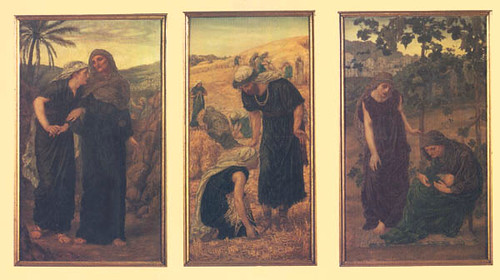
The Book of Ruth: Yahweh's Obscure Redemption through a Foreigner, Widow, and Wealthy Landowner
The story could not start off any worse. Famine in Judah has forced a small Hebrew family to flee their beloved homeland and find refuge in Moab. Yes, Moab. Elimelech, Naomi, and their sons, Mahlon and Chilion, are forced to shift residency and dwell among a foreign people.
It would be easy for us, as readers far removed from the foreign relations of ancient Israel, to skip over this detail and miss the intensity and offense that launches this biblical narrative into its subversive plot. But a Jewish reader or hearer living in antiquity would certainly not miss the punch that has been thrown.
The Moabites are enemies to Israel. They are dreaded dwellers in the region just opposite of Judah and across the Dead Sea. They are a people whose biblical ancestry stems from the incestual relations Lot had with his daughters (Gen. 19:30-38). The Moabites have not once demonstrated compassion or neighborly love towards God's covenanted people, actually their king sent Balaam to curse the numerous people who had "come out of Egypt" (Num. 22). They are ultimately remembered for leading Israelites into Baal worship through the seduction of a few of their women (Num. 25:1-3). They are then forever shunned and forbidden from the worshipping community and assembly of the pilgrimaging Israelites (Deut. 23:3-6; Nehemiah 13:1-3). That said, the writer of Deuteronomy incorporates among the miscelaneous laws for the nomadic Hebrews:
Yet this is precisely where this family from Judah now calls home. Their welfare is wrapped up in the welfare of Moab. But it gets worse, especially for Naomi."You shall never promote their welfare or their prosperity as long as you live" (23:6).
Wednesday, November 7, 2012
Sex, Sexuality, Youth Ministry, and The Church: Moving Beyond Accountability Groups
What was also very popular was the "accountability group." I was a part of several. They never seemed to last for more than a few months, if that. Same-gender youth, often with an adult leader, would meet on a weekly or bi-weekly basis and share about life. We read Scripture, prayed, and encouraged one another. But mostly these groups evolved into conversations about sexual "temptations," how to avoid them, and what to do if we "stumbled." These gatherings got real interesting whenever someone was dating another member of the youth group.
I am grateful for the willingness of my peers to be so vulnerable and open about a delicate and awkward topic. However, what resulted was a hyper-sexualized theology that was all about fear, avoidance, and unending anxiety whenever in the presence of a member of the opposite sex. God, faith, Christianity, and the church became about codes of conduct for co-ed interactions, especially romantic ones.
Then, many years later, I became a Presbyterian youth pastor. While sexuality was an important and highly debated point of conversation at the denominational level, it was not one the youth ministry was as interested in having corporately. It certainly was not at the top of desired retreat topics. We definitely refrained from preaching about it from the pulpit on Sunday mornings. As a youth pastor, I was somewhat relieved. Sex and sexuality are not exactly on my list of "Favorite Things to Preach About with Regularity."
This new reality was not because the youth or larger congregation did not have their opinions on the sensitive topic. It just seemed to be too delicate of a conversation to engage publicly, especially in a denomination where there is a beholder of every opinion and convictiction under the sun.
I venture to say that what prevented the topic from being discussed was/is fear.
Friday, August 24, 2012
Barth on Baptism: Excerpts of Summer Reading Part 1
And I was unsure.
I have always understood baptism as one's profession of faith in Jesus as Lord and the union of the new believer with a particular community of the baptized. It is a human response to the good news of God's once and for all saving action in Christ.
I have also understood baptism as a sign and symbol of God's claim on the baptized. It is God's announcement that "this is my child whom I love and am well pleased."
But which comes first- the human response or God's claim? When is someone old enough to respond? Should we not celebrate the good news that God claims us in Christ before we can even speak a word? But how can someone be baptized into a faith that is not actually their own?
Should we just double-dip everyone?
Is that what confirmation is all about, i.e. when we claim our baptisms and respond to God's already announced claim on us?
So we pondered: should we baptize Noah and Lily as infants or wait until they are old enough to profess faith on their own? Our tradition leaves it up to the parents, recognizing all forms of baptism, i.e. infant or believer's; sprinkling or immersion.
We ultimately decided to have our kids baptized on September 11, 2011 at the ripe age of nearly five months. It was a beautiful and sacred moment when we were able to celebrate, with our church and extended family, God's covenant made with our children and the shared responsibility to raise them in the Way of Jesus until they can claim this faith and covenant as their own.
But I still ponder, have we watered down the significance of baptism when we choose to sprinkle infants? Has baptism as a rite replaced baptism as a calling for new believers? Why is it so infrequent to see adult's baptized within Presbyterian and other mainline congregations? Are we not welcoming new believers into our communities?
I recently read through Barth's, "The Foundation of Christian Life," an excursus on baptism and the final published portion of his Church Dogmatics (Vol. IV.4) before he died in December, 1968 [2]. In this, the Swiss doctor of the church reminds the people of God that in and through our baptisms we become a "bearer of a new name," i.e. the name of Christ (3). We enter into covenanted relationship with all other gathered and scattered baptized as we live into the mission of God in and for the whole world. We join our history with the history of Jesus Christ, who continues to move the faithful forward and into the future redemption of all of creation (13).
Noah and Lily have not quite understood all this yet, despite my occasional whispering Scripture and Dogmatics into their ear. My prayer is one day they will. I also do not regret for a second the decision to baptize our babies versus wait until they are "of age."
Nonetheless, here are some excerpts from what I read recently, with minor commentary on a few surprising statements by the greatest Reformed theologian.
Friday, August 3, 2012
Eat Less Chicken? Neighborly Love and the Number 1 Combo
Number 1. No Pickle. American Cheese. Waffle Fries. Lemonade.
Six-piece nugget on the side if I am really hungry.
This has become one of my favorite meals to consume when I am on the go, on the road, or in the mall and craving a chicken sammy with BBQ sauce.
But as the Chick-Fil-A hype continues to build (or weaken), I find myself in a pickle.
Eat Less Chicken?
While I am not sure what the most faithful response to Chick-Fil-A may be, here are a few related rants that I have mulled over with friends, to include youth and adults, gays and straights, liberals and conservatives.
1. Stop Throwing Stones...and Nuggets, too.
Saturday, June 16, 2012
Our Father in Heaven? Father's Day Musings on an Ancient and Sometimes Difficult Metaphor
Baseball was more than a hobby in our family, it was the air we breathed. We spent hours at the local fields hitting buckets of balls and working on my footwork as a catcher behind the dish. My dad coached and our family traveled near and far as I played for a variety local and travel teams.
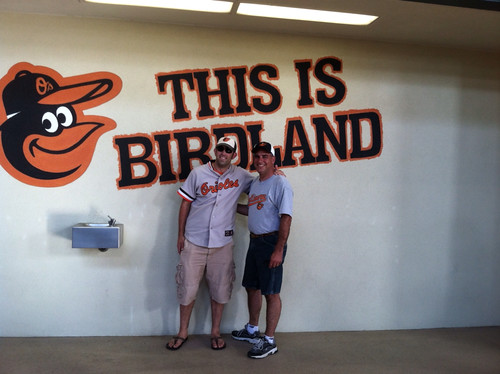
Oriole Park at Camden Yards was also our home away from home. The stadium was more than where we watched the Orioles win and lose many o' games. The Yard was where we shared life. The diamond became a sanctuary for conversations and life lessons. I always knew my dad was someone I could go to. I could trust him. He would listen. Baseball was simply a platform for these sorts of interactions.
These are all reasons why my dad was also my best man in my wedding.
While we have our share of differences, we remain close to this day. We are both in ministry and do the best we can to love God and love neighbor as we follow Jesus in Catonsville, MD and West Chester, PA.
I did not fully appreciate the relationship I had with my dad until I became a father of boy and girl twins nearly 14 months ago. April 21, 2011, will forever be the greatest night of my life. My kids have already taught me more about joy, hope, love, laughter, prayer, and trust than I ever learned in all the years that lead up to their arrival. My hope and prayer is that I will be able to be at least as good of a father to my children as my own father was to my siblings and me.
But for some, the hope is to be a better father than the one they had, or the one who left, or the one whom they never met. Many have strained relationships with their fathers, were neglected by their fathers, or were tragically abused by their fathers. Many fathers have perpetuated cycles of violence and dysfunction, leaving children to hope that just maybe they could be the ones to break the cycle.
Some have longed to become fathers and still wonder if that day will ever come; maybe that day never has come.
The term "father" does not always conjure up positive memories from childhood and adolescence. The word "father" can actually serve as a reminder of the very opposite, digging up all sorts of difficult and painful experiences past and present.
Yet, throughout Scripture and the history of Christian theology, God is confessed as Father.
Friday, April 13, 2012
Evangelism, Advocacy, and Church Growth: Ulterior Motives to Neighborly Love?
My involvement within each of these denominational settings, both lay and pastoral positions, has assured me that, when it comes to sharing the gospel and the pursuit of evangelism, we are not on the same page. [1] Evangelical churches often believe the sole obligation of the church is to "win souls" and to seek and save "the lost." Mainline denominations tend to prefer social engagement under the guise of the Franciscan mantra, "share the gospel always, if necessary use words." So, is the church called to verbal declaration or social transformation?
The dichotamy is false.
Monday, July 11, 2011
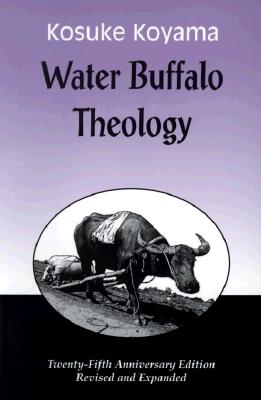
Water Buffalo Theology: A Must Read
“Has not theology inflated my language and thought?
Has this inflation kept me from real contact with people? Truly, theology is
more manageable than God” (151). These inquisitive
words of Japanese theologian, Kosuke Koyama, continue to echo throughout my
heart and mind even after reading his seminal text on theology and mission, Water Buffalo Theology. As someone who loves to engage theology and
the various contributions of historical and contemporary voices, I have
recognized the hazardous tendency to become overly cognitive and disengaged
with real persons and human experiences.
That said, Water Buffalo Theology was
a refreshing read, which I consider a vital resource for anyone who longs not
only to read and teach theology, but also and especially to live and incarnate God-talk
in a variety of cultural contexts. Kosuke
Koyama (1929-2009), an astute learner, teacher, and respected academic, is
intentional to bridge the gap between two sacred disciplines of the Christian
tradition, i.e. how we speak of God (theology) and how we live into such speech (missiology). He writes:“At this point theology becomes missiology, and missiology becomes theology. Is not theology a stammering description of the sending God culminating in the word of the cross? Is not missiology an understanding of God who is and acts in unsearchable and immeasurable strength of love culminating in the person and work of Jesus Christ” (135-136)?
Water
Buffalo Theology proceeds to engage the plethora of
Asian contexts and raise local questions posed by a situated gospel. What does this mean for the Buddhist in
Thailand? Who is Jesus in conversation with the likes of Confucius? What does
shalom look like to the Vietnamese in the wake of war, communism, and Western
imperialism? Can the gospel be understood aside from Western interpretations?
How does the church move beyond and guard against denominationalism and
institutionalization? How can we cross the dividing wall between library Christians
and street-Christians wherever we are? “To what kind of spiritual and theological heritage am I heir? This question is of immediate concern for me, for how can I make my witness meaningful to my neighbors if I fail to understand where they are and where I am in the continuing story of the Christian church here” (57)?
Monday, April 18, 2011
Reflection on Last Night's Jars of Clay Concert: Are They Still Relevant?
As I sat in the EU gym, I could not help but hear echoes of the makeshift student section hopelessly cheering on the Eagles basketball team, not to be outdone by the aged Tony Campolo, who was unashamed to give referees a piece of his mind (I hear he still does). I remember my attempts at fade away jump shots in intramural basketball games, a proud member of the Dirty Doaners. I could even hear the ping of the aluminum bat and the pop of my catcher’s mitt as I participated in another 6 a.m. indoor practice for our, also hopeless, D3 baseball team. And as I sat in the front row of the bleachers last night, I also was in full view of the many springtime relationships that were in full bloom amidst the crowd on the gym floor. And I wanted so desperately to warn them that summer break is about to come and, well, their freshman relationship may not make it and that’s o.k. because, my friend, sophomore year is on the horizons…
Second, the opportunity to listen to Jars of Clay perform a diverse collection of newer and older tracks was the most nostalgic experience of all. And, yes, they performed “Flood.” Ironically, last night marked 15 years since that album, and related hit single, was released. When Haseltine announced this, one of my students turned around and said to me, “I am 15.” Has it really been that long? I remember like it was yesterday, belting out, “rain, rain on my face” and “I want to fall in love with you,” as if I was in the studio alongside Dan Haseltine (shameful, I know). And yet, even after 15 years, Jars of Clay continues to release new albums, compose new and poetic lyrics, and raise social and political questions in regards to the gospel. This begs the question, is Jars of Clay still relevant? Maybe? While my students may not be able to recognize “Worlds Apart” or the lyric, “she sits in fields of wildflowers,” they are interested in the message and mission of The Shelter project…and so am I.
However, as a good friend of mine and I discussed the show as it unfolded, we were blown away at how much Jars has evolved over the years, not only in age and content, but also in style and focus. They have changed as the culture has changed. And while they may still be a sort of “Christian” band, they are not as settled as they once were. In fact, they seem to embrace ambiguity, celebrate paradox, underscore dialogue, and long for a life that bears fruit into the world versus appease a particular wing of the CCM industry. Lead singer, Dan Haseltine, said last night, “the greatest command is not about being right. When we stick our flags in the ground and claim a territory we move away from conversation and love and towards defense. The Christian faith is much more about a journey through mystery versus an arrival at a particular destination [i.e. intellectual, theological, political, etc.].” Then, with all the participants from The Shelter Tour, to include Audrey Assad, Matt Maher, and Derek Webb, they proceeded to perform one of their more poignant and newer songs, “Eyes Wide Open”:
So God bruise the heels we've dug in the groundAgain, is Jars of Clay still relevant? Maybe? Yet, this raises a much larger question, is the “Christian” music industry still relevant? Is contemporary Christian music (CCM) tired and endangered? Even more, is this endangerment really a problem or a gift of the Spirit? Relevant Magazine recently wrote:
That we might move closer to love
Pull out the roots we've dug in so deep
Finish what You've started
Help us to believe…
We can't go on, seems this conversation's done
It's so hard to win these fights and love You at the same time
So take my hand till grace makes a way to bend
Till the things I said to ruin only lead to my own end…
Draw us in, send us out…
Help us to believe
“In 2003, the number of artists who were Christians and making music outside of CCM was pretty small. You had people like MxPx and Sixpence None the Richer who would talk about not wanting to be labeled a ‘Christian band,’ but not many others. Then in 2005, Sufjan Stevens released Illinois and suddenly Christians were seriously considered as artists. Christian artists seem to be popping up everywhere- bands like Cold War Kids, Mute Math, Shad, the Avett Brothers, the Civil Wars and Switchfoot have all had critical and commercial success. Christians have successfully moved out of the faith ghetto and into artistic merit” (March/April 2011). [2]If you follow any of my blog you may know of some of my recent musical interests, particularly Mumford & Sons, who will not be seen at Creation or Purple Door Festivals, rather Lollapalooza and Bonaroo. And I prefer their music…
Nonetheless, there is something to be said for Jars of Clay, and my preferred, Derek Webb. [3] They have credibility with the church (depending on who you talk to), whose people may benefit from their message, craft, and approach in a way that would not be feasible if the CCM market completely died. And in a way, Jars is still relevant for that very reason.
So while my students may not always know of Jars of Clay, or worse, Derek Webb, I will still take them to their concerts, because I think their voice and witness is still relevant.
Notes:
[1] Assad said something profound last night, "Love is self-donation. This is particulalry difficult when love is young." This remark was in reference to here recent marriage; however, I think the implications are much broader...
[2] See also their column, “2011 Could Be the Year When CCM As We Know It Disappears (except for Worship Music],” in the same issue, “The number of people who exclusively listen to Christian music gets smaller every day, which takes some of the security out of solely being a musician in the industry. You might not be able to make money just off Christians anymore, which sort of spells doom for the business model as it currently exists. There is, however, an exception: worship music” (p. 77). See digital issue: http://www.relevantmagazine.com/digital-issue-50
[3] I say this in full recognition, and in light of personal conversations with Derek Webb, that neither he nor Jars of Clay consider themselves a "Christian band." Instead, they are confessing Christians who make music for a living. This is an important departure from the previously-held notion that an inanimate object, i.e. music, could be "Christian." Furthermore, Webb made a great comment in reference to his recent Feedback album, that music is just another means for confessional language, whereby he sometimes prefers such language to be void of lyric and much more mysterious and messy.
Monday, April 4, 2011
Scripture, Questions, and Formative Ellipsis
I love how the book of Acts, the story about the church in its earliest beginnings, incorporates a vast collection questions:
What does this Jesus event mean? Is the kingdom we had hoped for finally to be restored?
How should we then live in light of this Jesus event?
Who is to join us as we continue to follow Jesus in the world, after he is gone… as we wait for his return?
What is required of us? What about the Law?
To whom do we pledge ultimate allegiance?
How long will it be until Jesus does return?
What does it mean to be saved…and who is? All humanity? All of creation?
And Lent is the season to ask hard, really hard questions.
And we are invited to ask questions in light of the Bible and how God reveals God’s self through it.
And ambiguity is o.k.
I suggest that the Bible is an open invitation to ask questions about God, Jesus, darkness, pain, suffering, hope, life, things to come, war, justice, peace, relationships, salvation, heaven, hell, the list goes on…
And ambiguity is o.k.
But the Bible is meant not to collect dust after third grade, weeks after confirmation, or in between Sunday mornings or evenings, but to be read, engaged, questioned, affirmed, wrestled with, and prayed through.
And the Bible forms us, through our questions, to be God’s people in the world.
And Lent is a beautiful season to read, engage, and ask honest questions about the Bible and story of Jesus.
This past week the Imago Dei Youth Ministry questioned the Bible. Instead of suggesting some sort of reduced system or formula for reading the Bible we invited the high school and middle school students on a pilgrimage of inquiry through both beautiful and hard texts. A variety of passages were scattered on the floor throughout the Westminster Chapel and newsprint hung on the walls. The only requirement for this formative quest: ask and write questions.
And no question was off limits…
Questions about God. Questions about Jesus. Questions about the world, past, present, and future. Questions about life. Questions about the imago Dei. Questions about the story of God and our role in it. Questions about death.
And these are some of the questions that the Spirit of God stirred within the hearts of the Imago Dei Youth…
Psalm 22
• Is God far away or are we far away from God?
• Why does it seem that I have to fall before I can get closer to God?
• Why do people have to mock you before believing in God/
• Why does it seem so long when we suffer?
• How can I clean my link to God?
• How can I have a closer, better, more reliable connection to God?
Isaiah 65:17-25
• Does God’s love extend to all? Including those who don’t participate in the faith?
• Why have I refused to be ‘glad” in what God is creating and settled for sorrow in what is?
• Why must the serpent eat dust while all other creation is blessed, if even he was one of God’s creation?
• What does it take to find this peace? Why can’t we have this today?
• Why just Jerusalem?
• Why forget things? Why not remember all good things?
Job 24:1-12
• How could God not hear their prayers?
• God says the meek shall inherit the earth. Yet he allows them to be wronged. Why?
Colossians 1:15-20
• Why Jesus Christ? Why not?
• Were things in heaven not peaceful before Jesus’ blood was spilled?
• Were evil and oppressive rulers made through Christ?
• Why is God always invisible?
• Why did Jesus choose his blood to be reconciliation?
• If all things hold together in Jesus, why so much present fragmentation?
• We can’t we see all things of God?
• Why do humans believe they are the head of the church?
• If God weren’t here to hold all things together, would everything fall apart?
Philippians 2:1-13
• How do I work out salvation with fear and trembling?
• Is it asking to become a slave to God?
• How have I exploited others with the gospel instead of loving them?
• Why fear and trembling?
• How are people so selfish when Jesus was so selfless?
• If of one mind then what makes us unique?
• Why bend your knee to Jesus and not to another important individual?
Revelation 21:9-22:7
• Why isn’t Jerusalem in this condition now?
• When will God’s kingdom be made complete? Will there be people who are not there?
• Why was it only shown to John? Why was he chosen?
• Why so specific?
• Why sets of three or four always adding to twelve?
• Why is Jerusalem the wife of the lamb?
• Why built of jasper?
• Length, width, and height equal?
My prayer for the students who were present, and for all of us, is that this experience would launch us into a formative ellipsis. That is, as we read Scripture let us look, not for definitive end points or absolute answers, but for new and fresh questions that provoke our prophetic imaginations as we strive to be the people of God in the world.
The Scriptures can, even should be, engaged by all…and no questions are off limits…
Notes:
[1] This is not to say that the teacher does not play a pivotal and mediating role, for if this were the case I would not feel called to do what I do. Instead, God's people, as individuals and communities, should not pull back because of our questions rather press on as a result of them. And there are indeed many great resources available to aid us in our quest through questions of context, symbols, language, and paradox. I suggest four significant resources: N.T. Wright, How Can the Bible Be Authoratative; Brian Walsh and Sylvia Keesmaat, Colossians Remixed; Wes Howard-Brook and Anthony Gwyther, Unveiling Empire: Reading Revelation Then and Now; Rob Bell, Velvit Elvis.