Showing posts with label Homebrewed Christianity. Show all posts

Tuesday, May 22, 2018

Intrapreneur or Entrepreneur? Prophet or Priest? The Whole Church Called to Innovation.


When I was in seminary, one of the critical differentials discussed for ministry leadership was between the prophet and the priest.

A prophet is one who is willing to work outside the bounds of a given (religious) system and institution for the sake of work they discern to be of value to a community and in rhythm with God’s mission to reconcile the whole world. A bit reductionist, I know, but bare with me. This involves variable risks and the willingness to speak truth to (religious or social) powers when they are at odds with that very mission. Even more, these prophets are willing to create alternatives, i.e. grassroots movements, newly organized communities, etc., to those very systems and institutions. Prophets refuse to wait for the change they long to see. Prophetic work is hard, sometimes lonely, and can possibly put a leader at odds with the very hands that feed them.

There is plenty of room to nuance more and better, but the point is we need the prophets among us. Institutions without an ear tuned to the voice of the prophets can become oppressive in function, perpetuates of injustice, and breeders of despair within the contexts they were established to serve. 

Then there is the priest. A priest is the face of both the institution and the people, even a mediator between the two. In the biblical story, a priest mediates among the people, the institution, and God. The priest serves a vital role in the community, intended to be an arbiter for God’s justice and reconciliation. Priests wear the garments of the (religious or social) systems, speak the language of the institution, and are charged with moving the sacred and shared narrative forward for the sake of the generations to come. In a word, priests are charged with the work of sustainability. This call is not for self-preservation alone; rather, their call is because the story is so good it must be told and retold, shared and proclaimed from the holiest of holies to the outer courts and margins of society.  

And we need the priests among us. Prophetic work without priestly partnerships are more vulnerable to isolation and death. In this sense, if the priests have their eyes and ears attuned to the good word and witness of the prophets, daring to partner together, these movements and alternative communities can be sustained and effect change in the larger institutional narrative and corporate witness in the world. They can even minimize (eliminate?) oppression.

Full stop. 

Over the last few weeks, I have stumbled into numerous conversations that have highlighted the word, “intrapreneur.” I was familiar with the buzz word, “entrepreneur,” being waved as a banner among ministry innovation circles, but this one was new to me.  Yet it made sense. 
“You will be familiar with entrepreneurs, those individuals who set out to create something special, generally via a start-up business model. They are the ideas people, the disruptors, the individuals who have seen an opportunity and are out to make a difference. You may not be aware that key individuals within your organization display the same traits. These are the intrapraneurs, the individuals who are not content to sit back but who have a burning desire to help their organization to succeed and the imagination and drive to carry change along with them. Intrapreneurs are the organization’s natural innovators, comfortable with navigating uncertainty and exploring new terrain. They apply entrepreneurial thinking and actions to the role which they play within the organization and that means that above everything else they embody the fact that innovation is everyone’s job” (Building a Culture of Innovation 162). 
There it is, live and in the world of corporate innovation. Prophets as entrepreneurs and priests as intrapreneurs. Together called to ministry innovation in and through grassroots movements and religious institutions able to effect sustainable change in the neighborhoods, communities, congregations, and larger world God so loves. 

Here I also found a little nugget of self-discovery. In the midst of all the pressure to be entrepreneurial as a minister, community leader, and presbyter, I found renewed energy in the possibility that my gift set was more intrapreneurial (for now). As an intrapraneur, I am called to collaborate and innovate within the systems (read: presbytery and church) that can be good and must always strive to be better. Intrapreneurs are able to energize, empower, equip, implement, and work to sustain new possibilities within a given organization and to strive to serve as partners with those more entrepreneurial in nature. While there are quibbles about who is more innovative, risk-taking, and faithful to the collective story, we need both. Prophet and priest. Entrepreneur and intrapreneur. They are each vital vocations with their own quirks and pitfalls, hopes and aspirations. They are not to be opponents or binary tracks. There's actually great overlap.

This is where Anna Mazzone drops knowledge:
"Suits or sneakers? Suits AND sneakers! While intrapreneurs and entrepreneurs both try to to solve a genuine problem, the level of chutzpah or mannerliness, the risk and reward, the degree of freedom, the resource opportunities, the network, and maybe most prominently the environment in which they function, are different. They do share having that entrepreneurial DNA, and so it’s no wonder that we see a growing number of people switching roles from being an intrapreneur to becoming an entrepreneur- and vice versa. In a future workplace where one will pursue several careers in one lifetime, it’s probably best to focus not on the title per se, but on further developing the underlying personality and mindset and improving the environment for accommodating both in your organization.” (“Suits vs. Sneakers,” Nitzan Merguei, Academy for Corporate Entrepreneurship Blog. Aug 19, 2016). 
Would love to see more discussions in the church related to both offices and calls. I am barely a beginner in this learning lab. But I do believe this conversation could help leaders in varied places be more collaborative at grassroots and institutional levels of the church as we share the work of ministry innovation. 

After all, innovation is everyone’s job.

Helpful Reads:
Beswick, Chris, Derek Bishop, and Jo Garaghty. Building a Culture of Innovation: A Practical Framework for Placing Innovation at the Core of Your Business. Philadelphia: Kogan Page, 2016. 

Merguei, Nitzan.  “Suits vs. Sneakers,” Academy for Corporate Entrepreneurship Blog. Aug 19, 2016: http://www.afce.co/old/whats-difference-intrapreneurs-entrepreneurs/ 

Myler, Larry. “Intrapreneurs Are Just Like Entrepreneurs…NOT!” Forbes. Jan 15, 2014: https://www.forbes.com/sites/larrymyler/2014/01/15/intrapreneurs-are-just-like-entrepreneurs-not/#674448f0354e 

Saturday, July 4, 2015

Hoping Alongside Communities of Despair: One Truth Gleaned from the Karl Barth Pastor's Conference 2015

If I were to do it all over, I would have begun again at the beginning.  While the Karl Barth Pastor’s Conference was great, I should have attended the full week of dialogue, paper presentations, and interactions with some of the more gifted theological minds our Protestant Christian tradition has to offer. (Also, I would have received this bag as a gift versus lucky leftover.) Instead, I settled for live feeds of the likes of Moltmann and Migliore and headed to Princeton Theological Seminary for the tail-end of what some referred to as “Barth Camp for Pastors." 

Still, I was not disappointed. 

I was also right where I needed to be. 

As the tragic events of Mother Emmanuel AME continued to occupy the hearts, minds, and prayers of attendees, we were reminded by Dr. Willie Jennings that Barth’s work must refuse to remain as mere rhetoric for disengaged and irrelevant theologians.  Instead, pastors and preachers must engage Church Dogmatics as means to resist the racial disorder of the world.  Jennings remarked, “Christian faith should create an alternative vision to current racial divisions…The issue is not do you hope but it is from where do you hope and who do you join in hope.” 

While society likes to tout progress, frequently synonymous to the innovation in technology, increase in productivity, and advancements in mechanisms for national defense, we are actually underdeveloped in our racial relations. Hatred is perpetuated by historical and cultural symbols; powers intended to protect often prioritize the privileged through profiling and prejudice; sameness remains the preferred method for gatherings in social, political, and religious arenas; solidarity is often offered from a safe distance. Dr. Jennings challenged this cultural cowardice, “We cannot hope within a community of homogeneity.  We need to hope within communities of despair….The problem- we believe we are coherent in communities of homogeneity.” 

These prophetic challenges, delivered to a gathering of preachers and teachers of the Christian faith, are rooted in the contributions of Karl Barth who dared us to link arms with both near and distant neighbors (Church Dogmatics III.4). The Swiss theologian, who more often than not took on the role as advocate and activist in the midst of Nazi Germany, refuted national and racial idolatry that frequently breeds oppression and injustice. 
“In this respect, too, [the Christian] cannot return to the prison and stronghold of his own national [or racial] limitation.  As he holds his near neighbours with the one hand, he reaches out to the distant with the other.  And so the concept of his own people is extended and opened out in this respect too.  It is true that he belongs wholly and utterly to his own people.  But it is equally true that the horizon by which it exists as his people is humanity.  It is equally true that he himself belongs wholly and utterly to humanity” (Church Dogmatics III.4, 298). 
There was so much wisdom gleaned from those who gathered at Princeton to reflect on Karl Barth’s contributions to Christian theology. I will save such musings for another time and place. For now, both Barth and Jennings remind us we must return over and again to the beginning question Jesus posed to his earliest disciples: who is my neighbor? 

More frequently than not, we will discover our neighbor is revealed in persons and communities of diversity and difference with whom we are called to join hands in hope amidst great despair. 

I pray this call would claim more space in religious, political, and casual rhetoric as we wrestle with the ongoing reality of racial divisions further exposed in the recent events in our nation and Christian churches. After all, we belong wholly to one another and all of humanity. 

**Grateful for time spent with Rev. Dr. Will Willimon at #KBPC2015**

Thursday, December 5, 2013

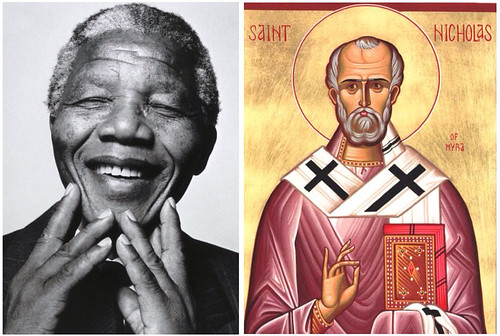
Celebrating Nelson Mandela on the Feast of St. Nicholas

I was dreaming up a blogpost on the legends and myths of St. Nicholas when I heard the news of the death of Nelson Mandela. I was eager to write a few reflections titled, "Santa's Real: The Man Behind the Myth," when I learned of the South African freedom fighter's passing from this life into life eternal. Mandela's long walk to freedom had finally reached the end. Better said, Mandela entered God's great liberation that will one day behold us all.

I am no Mandela scholar. I am a novice when it comes to the history of South Africa and the struggles with apartheid. I was ten when he took office and vaguely remember watching his inaugural address on t.v. in history class. While his autobiography, A Long Road to Freedom, is at the top of my list of all time favorites, I would have to google quotes for this post.

But we don't need the writings of a saint, letters of a hero, or verbatims of revolutionaries in order to be moved and shaped by their legacy. Their lives and witness take on a spirit of their own, influencing generation after generation to live into the same ethics and virtues of these icons of faith, justice, and commitment to the common good.

So as I sit hear drinking my coffee on December 6th, a date marked for the Feast of St. Nicholas, I find it fitting to do so with a streaming of tributes to Mandela in the background. Afterall, the fourth-century bishop of Myra and our generation's greatest patron to justice and reconciliation hold much in common.

There are stories of St. Nick secretly liberating three young women from being sold into prostitution by their father, who was on the brink of poverty. Tossing bags of currency through down chimneys and windows, which landed in the middle of dinner tables and even a sock hung up to dry, St. Nick looked for secret and subtle means to set captives free. He was, in a way, one of the earliest advocates against human trafficking.

While Mandela was the oppressed fighting for liberation, St. Nick used his privilege to do the same. St. Nick, who came from a wealthy family, leveraged his status and protested corrupt empires, politicked against unjust taxation, interrupted the executions of the innocent, struck down oppressive idolatry, and advocated for children near and far. The saint who would be co-opted by Coca-Cola commercialization and mutated into Santa Claus, was more than jolly. Nicholas of Myra was a religious and social revolutionary who was fueled by far more than milk and cookies.

"More than public charity or personal purity, Nicholas devoted himself to justice, to righting wrongs and correcting inequities. These were the concerns that characterized his life. He was more than a public defender of course; he was a minister of God." (Adam Engish, The Saint Who Would Be Santa, p. 79)

And like Mandela, Nicholas spent time in prison. It seems most advocates of God's dreams for the world do.

I have to get me a record.

People have often asked if Amber and I are going to play Santa Claus with our kids.

The jury is still out.

We want our kids more versed in the legends and praxis of St. Nick than the over-commercialized icon of materialism.

We don't want the revolution to die.

And when I consider that my kids will never see Mandela live on t.v., I want to make sure they learn stories of this twentieth and twenty-first century saint, too.

So we are going to have to tell them all kinds of stories. We are going to have to embrace a variety of traditions and maybe craft a few of our own. If we want the revolution of love, justice, and peace to be embraced by our children, we must tell the tales and leverage the legacies of heroes and sheroes of the faith.

There are plenty of tales and legends to tell.

Happy St. Nicholas Day.

And by the way, Mandela Day is July 18th.

Resources:

The Saint Who Would Be Santa Claus by Adam C. English (www.saintwhowouldbesanta.com)

Blogpost with Adam English and link to an excellent podcast about hardcore St. Nick: http://homebrewedchristianity.com/2013/12/02/whips-and-sticks-and-good-music-st-nick-has-it-all/

www.stnicholascenter.org

The Saint behind Santa Claus: http://www.relevantmagazine.com/god/church/features/23886-the-saint-behind-santa-claus

Nelson Mandela: Dreamer of Big Dreams: http://www.pcusa.org/news/2013/12/5/nelson-mandela-dreamer-big-dreams/

www.nelsonmandela.org

Mandela quote above pulled from Kristen Howerton's Facebook page. Check out her blog: www.rageagainsttheminivan.com

Saturday, March 23, 2013

Rob Bell Has Come Out...with a new book. O yea, and as affirming of gay marriage, too.

Rob Bell has come out...

...with a new book.

What We Talk About When We Talk About God is more or less a culmination of Rob Bell's progressive and evolving theological convictions that eventually led to his departure from Mars Hill Bible Church. While the Evangelical world tends to stop and quiver anytime Bell speaks, or writes, or releases yet another vignette with dramatic pauses and obscure metaphors (like Oldsmobiles), I found his latest publication everything but controversial, ground-breaking, or worth Tweeting statements like "Farewell, Rob Bell" or "R.I.P. Rob Bell."

Instead, per the usual, I consider his work a welcome resource within my library of What I Try to Talk About When I Try to Talk About God with those who may not be interested in pouring their life into dense theology, philosophy and cultural exegesis.

That is, I liked it. Not as much as some of his others, but I liked it. I will recommend it, with fair warning- he talks a lot about quantum physics. But hang in there.

Bell has a knack for communicating complexity with clarity, for which I am envious and grateful. The pastor/film maker/writer/innovator/preacher/practitioner cleverly draws readers into the good news of God's love, which wins every single time.

However, what many readers often miss is that Rob is not saying anything new. Instead, books like Love Wins and What We Talk About... are rephrasings and anthologies of Christian theology that have been reduced to the margins by Evangelicals, yet embraced by mainliners and progressives for centuries. Just read his endnotes :) And if you are looking for more well-versed theology, read the primary sources instead.

Origen.

Paul Tillich.

Hans Urs von Balthasar.

Richard Rohr.

And my favorite, Karl Barth.

That's right, while some claim that Rob Bell is spitting out reverberations of Process Theology, which he certainly may, I find his work also reflective of the greatest theologian of the twentieth century- Karl Barth.

The thrust of his book hinges on God being forever for us in the person of Jesus. Better said, Jesus is God's universal YES to humanity and NO to anything that distorts God's intentions for all that God made as good and beautiful. See Barth.

Bell also reiterates much of his rhetoric from his speaking tour, The God's Aren't Angry, by underscoring God as "pulling us forward." That is, God continually propels us into God's new creation work and reconciliation of all things. God is not situated in the past. God is on the move and in the process of changing the world; a process that culminated in the resurrection of Christ. Barth says it this way:

“As such and with independent truth and power calling is man’s forward direction to God as his future, his new creation as a being which not only derives from the sentence of God in faith and is placed under his present direction in love but beyond that receives and embraces His promise in hope, looking forward therefore and moving forward to Him” (Church Dogmatics, IV. 4 p. 109).

Yet the most telling affirmation of Bell and Barth as (should be) "dance partners," to borrow yet another of his favorite images, is his insistence that God cannot be fully possessed or contained. The moment we think we have fully understood or possessed God, we have actually missed God altogether. We will have turned God into another idol, maybe the worst kind- absolute theological and dogmatic certainty.

Ah, Barth would be proud, "Theology must describe the dynamic interrelationships which make this procession comparable to a bird in flight, in contrast to a caged bird" (Evangelical Theology 10).

God is free and uncontainable, neither by Barth nor Bell. Not by this blogger or any Evangelical critic.

Still more, while Rob Bell may be trying to give a nod to his good friend, Peter Rollins by citing him:

"When it comes to talking about God, that which we cannot speak of is the one thing about whom and to whom we must never stop talking" (96).

Again, that's Barth, not Rollins or Bell:

"As ministers we ought to speak of God. We are human, however, and so cannot speak of God. We ought therefore to recognize both our obligation and our inability and by that very recognition give glory to God” (The Word of God and the Word of Man, 186).

I say all this not because I am disappointed, rather thankful. I am not frustrated, simply bewildered. What others talk about when they talk about the rejection of Bell and his theology is actually nothing new. I also don't think it's honest.

What others are really talking about is the rejection of what has already been said before.

I also think what many are talking about is envy and fear. Critics are envious of his ability to speak with authenticity and clarity what many of us, maybe most of us, are actually thinking. They envy his ability to communicate the gospel in a way that actually draws cynics and skeptics into the community of faith others have been trying to preserve and defend for so long. Many envy his creativity and reputation with artists, poets, film makers, the Dalai Lama, and Desmund Tutu, who are working for the transformation of creation. Many may envy that God is actually at work in the other, the different, the liberal, and those who do not fit within labeled theological boxes.

Many may also fear he may actually be on to something that challenges how we go about our work, our witness, and our approach to Christian theology and mission.

O yea, and Rob Bell also came out...

..as affirming of gay marriage. (listen to the excellent interview here)

Many fear that, too.

But I am grateful, because what he talks about when he talks about God is extremely helpful for furthering the conversation about faith, gospel, and life lived as a disciple of Jesus within an ever-changing world that still longs for good news.

That's what I want to talk about. What about you?

"The beautiful thing would be if evangelical came to mean buoyant, joyful, honest announcement about all of us receiving the grace of God and then together giving back to make the world the kind of place God always dreamed it could be."

---Rob Bell


Related Posts:

An Invitation to Rob Bell by Greg Carey (Huffington Post)

Rob Bell Comes Out for Marriage Equality by Greg Carey (Huffington Post)

Why Rob Bell Still Matters to Me by Tim Ghali

Why Rob Bell Still Matters by Tony Jones

Karl Barth and the Doctrine of the Word of God: The Beginning and End of Missional Proclamation

Wednesday, March 6, 2013

Song for My Family: Güngör as Modern Psalm for Lent

A few weeks ago, Michael Güngör led a few songs as closing set for The Justice Conference 2013. Most attendees were able to sing along with "Beautiful Things," a fresh reminder that a world flooded with injustice is also in the process of being made new. However, his opening ballad, "Song for My Family," was not as easily recognized. The closing track to The Michael Gungor Band's (now simply Güngör), Ancient Skies, was a provocative melody for all of us who were wrestling with the tension between what goes on within the walls of the church often at the expense of what is going on beyond the walls, in the real and broken world. (full lyrics here)

Please forgive our ignorance

In looking down on you

Please forgive our selfishness

For hiding in our pews while the world bleeds

While the world needs us to be what we should be

I could not help but add this older lyric to my 2013 Lenten playlist, a humble confession of the body of Christ's negligence and confusion in regards to where the concerns of the church really should hinge. It is reminiscent of both the prophet Amos and Jesus' parable of the Good Samaritan.

Read Amos 5:21-24 and Luke 10:25-37

Thoughts to Ponder:

1. In what ways has the church, to include you as an individual, mistaken the things of the church for the mission of the church?

2. How would you respond to Güngör's charge to the church, "be what you should be?" What is the church called to be?

3. How have we been "hiding in pews while the world bleeds?" What does this mean for the church locally and globally?

4. How do both the prophetic words of Amos and the parable of Jesus in Luke pertain to this modern psalm by Güngör?

Close with a prayer of confession and invite God to confront you and call you to shift your eyes and ears to the concerns of your neighbors near and far.

Maybe invite those outside the walls of the church to participate within the walls.

Even better, go beyond the walls of your church and enter into community with your neighbors.

Consider what it would look like, and then embody it, to serve alongside the most vulnerable of your town, city, community, etc.

After all, we are all a part of the same human family.


Related Post: Dry Bones: Güngör and Lenten Worship

Also check out Homebrewed Christianity's Interview:

The Crowd, the Critic, and the Muse with Michael Gungor

Tuesday, June 12, 2012

Is It Local? Portlandia and Gospel (re)Discovery


There is a phrase that is thrown around a lot in our congregation, "buy fresh. buy local." This slogan is intended to encourage citizens of West Chester to support local businesses and prepare meals with fresh produce. The food industry is breeding grounds for social injustice, human oppression, and creation exploitation. So "buy fresh. buy local." has been endorsed by our faith community in efforts to speak to God's concern for the whole creation, not only humanity. This campaign invites us to develop a social conscience and raise questions about where and how our food is grown, harvested, and sold.

That said, if you hang around Westminster long enough, you will hear many in our community ask similar questions to the ones asked by the hipster in the Portlandia vignette, "is it local?"

Yet Amber and I, more often than not, buy in bulk. Our food comes from all over the country and all over the world. It is certainly not fresh. It is easier, cheaper, and faster to buy packaged and preserved products. Still, I am convinced that many of the migraines I have experienced of late are not only the byproduct of stress, but also the result of a steady diet of preservatives and MSG.

This got me thinking, is our gospel local? Is the Jesus we proclaim and the Messiah we invite others to follow pertinent to the local concerns and questions of our immediate context or is our message packaged in some mysterious ecclesial farm and coated with theological preservatives and MSG?

Does it give you and your neighbors a migraine?

Doing local theology is hard. [1] It demands that we enter into community with our neighbors whom we may see while mowing our lawn or purchasing local produce. Local theology requires disciples to ask questions like, what is the good news either longed for in my community or already alive and well in my neighborhood? How does the good news of Jesus speak to both?

Local theology assumes that the faithful will serve alongside the poor and afflicted not only in the sexy parts of the developing world or major cities, but also and especially in the borough just down the road. God's call of discipleship demands that we not only advocate for the oppressed in Sudan, but also the bullied at Stetson or Pierce Middle School; we not only lobby for the hungry and homeless on the Avenue of the Arts in Philly, but also on High Street in West Chester.

Local theology asks the same question Jesus posed to Peter, "who do the people say that I am?" (Mark 8:27). Then local theology responds to this same Jesus' invitation to incarnate fresh expressions of the gospel among those very people.

I have been in youth ministry for a good while. Yet it was not until last summer when I realized that our youth ministry was not "local." While we had great relationships in Philly and beautiful partnerships in Honduras, we did not know much about "Colin" and his friends in West Chester. We certainly did not have any significant partnerships in our immediate context whereby we could ask questions of faith or build community of hope among our neighbors in the borough.

So we initiated SoMEthing. That is, we dreamed about a Summer of Missional Engagement (SoME) that would concentrate on related hopes and dreams in the borough of West Chester. We grabbed a list of the ministries our church has supported financially for years and began to consider how we could follow dollars and cents with people and presence. The primary stipulation, it must be local.

We have begun significant conversations with a few service organizations and faith-based programs that have excited us with possibilities to enter our community and be God's people alongside God's people there. We are not sure what this will look like in three weeks let alone a year from now. What we do know is that the Imago Dei Youth Ministry is going local this summer.

Through SoME, we expect God to open our eyes and ears to new possibilities. We encourage real questions and relevant extensions of the gospel among our neighbors whom we are sure to run into as we jog throughout the borough or when we purchase our local (or not so local) produce at the grocery store. In the end, or the beginning, God will go with us as we refrain from a ministry diet of packaged programs and reconsider what it looks like to do local youth ministry.

I am eager for the questions that will follow. I look forward to dreaming together with new and old friends as we look to embody God's kingdom throughout the borough of West Chester.

Actually, I am mostly excited to see how God's kingdom is already alive and well in these places, maybe we are just late to the party...or just in time...

The kingdom of God is universal, yes.

But it's also local.

Note:

[1] A great read is Doing Local Theology by Clemens Sedmak (Orbis 2002).

**Also, a related podcast from Homebrewed Christianity: Global Leadership and Local Christianity

Monday, May 21, 2012

The Hunger Games: Prophetic Satire in Pop-Culture Story

I am well aware that I am a late arrival to The Hunger Games party. Thanks to the constant nudging of my high school students, my finger tips were just barely able to grasp the bumper of the Suzanne Collins bandwagon. I am not a fan of trend. I am cynical about pop-culture. I never opened a page of the Twilight saga, although I did watch the first film. Not impressed. Instead, most pop-culture, while a sure testament to contemporary whims and fads, is border-line kitsch. This is not to suggest that I am the best judge of art and culture. I am not. It is just to say that when it comes to the New York Times Bestseller's List, I am more often than not left disappointed.

Then I read The Hunger Games.

The stories within the trilogy are not the best books I have ever read (actually, I still have to read the third book, Mockingjay). However, I believe they are the most prophetic "literary" contributions by pop-culture in quite some time. Suzanne Collins is able to elicit with brilliance and creativity a subversive satire on contemporary politics, social concerns, ideological propaganda, and the oppressive myths that dominate our modern world. And youth play a central role!

That being the case, The Hunger Games caused me to ponder, how can youth ministries and churches engage these prophetic narratives as platforms for theological discussions about Christian work and witness in the world? Even more, how can we uncover truths within The Hunger Games, truths that shed light on our contemporary world not so different than the one illustrated throughout the 12 Districts. In other words, The Hunger Games is more than pop-culture entertainment, that is, if we have the eyes to see and the ears to hear.

So, as a means to begin related conversations within the Imago Dei Youth Ministry and to wrap my brain around what I have initially encountered in The Hunger Games, I developed a few musings drawn from this prophetic satire: