Showing posts with label Hermeneutics. Show all posts

Sunday, February 14, 2021

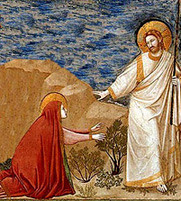
The Word Made Speechless? Transfiguration Sunday and a Lesson from James Baldwin


I am not sure how I missed this the bagillion times previously I read the story of the Transfiguration.

“He [Jesus?] did not know what to say, for they were terrified.”  
(Mark 9:6)
Sure, maybe the "he" is referring to Peter. I have mostly heard it preached that way. Peter's question about house-building on the mountain framed in retrospect as one of those speaking-before-thinking moments par for the course for this disciple. The exegesis of this text may even favor that...it may.

But senus plenior* be damned. What if God-in-Flesh was speechless? What if the Word Incarnate was without words? What if Jesus was modeling presence before preaching, which we all could use a refresher course? What if this is why Jesus was the one to listen to, because the Way of the Christ was rooted not in truisms of power and more so in incarnations of love and grace? What if this is what made Jesus' words so powerful when they did come?

Sometimes fear warrants more than the language of our lips. Sometimes trauma transcends trite verbiage. Sometimes what we need is not found in statements and discourse, but is discovered in humble empathy and how we move compassionately in and through and for the world.
I think this is a large part of the message of the Transfiguration, transforming the focus of God’s people away from the traditions, doctrines, laws, and language of exclusion and illuminating the better way of love that leads through intentional actions of universal embrace. No, we cannot stay here in isolation, the story tells us. We must go down the mountain.
James Baldwin said it best when he wrote these words to his nephew, both who knew their fair share of terror and trauma, about his singular focus in life:
“For here you were, Big James, named for me- you were a big baby, I was not- here you were: to be loved. To be loved, baby, hard, at once, and forever, to strengthen you against the loveless world.”  
                                                               (My Dungeon Shook)
On this Transfiguration Sunday, shared with Valentines Day, may we find ways to love others hard, at once, and forever. May we know this kind of love, found in Jesus the Christ, which is not limited to our words and envelops each of us. This love sometimes needs not to be spoken at all, but always calls to gracious and hospitable actions in a world both beautiful and cruel. So go on down that mountain...and remember the tone of your presence often matters more than your preaching.
---
*"Plain reading" of the text, which doesn't actually exist. The pronoun is ambiguous and leaves room for mystery. Don't fear it. Dwell in it.

Image above was taken on pilgrimage to the Holy Land. The hill in the distant is the traditional location of the Transfiguration.

Monday, September 21, 2020

Grumbling about the Absurdity of Generosity and Universality of God's Economy

“So the last shall be first and the first shall be last.”

Parables are tricky. These ancient riddles subvert convention and dare us to expand our imaginations for the common good. Parables are sacred mysteries. Parables are playful. Parables are brutally honest about the way things are and the way things can and should be. Parables cut through the binary of either/or and call us into something far more inclusive. Yet we, from ancient days until the present, prefer competition over inclusion, me and mine versus a collective us. So we may not like parables- especially not the one in Sunday’s gospel lectionary from Matthew 20:19.

As I read Jesus’ parable of a landowner who hired workers for his vineyard, I could not think of a more potent passage for our current socio-political entanglement. The hired hands received the same wage, whether they worked a full day or only a small percentage. And those employed first, the Scripture says, “grumbled,” believing they were entitled to more than those who were hired last and worked less.

Here we must pause.

We do not know why some workers were hired first. Did their privilege make them more accessible to employment opportunities? Did they have an “in” with the vineyard owner? Were they born into the trade required to make the deep reds? 

We also do not know the story behind those hired last. Maybe they had a record or physical challenges or had to work covertly so not to be picked up by those who had it out for them for their unpaid debts? Maybe they couldn’t work a full day because they had a large family to care for and little to no help at home. Maybe they were born into circumstance or class whereby they were considered less than those hired first. 

Whatever the reason, the last and the first and those in between were all given a vocation by this landowner and each received the same compensation. All were paid. All were included. All had enough. Still, the first grumbled, forgetting equity did not tilt the scales in the favor of the last at the expense of the first. "Friend, I am doing you no wrong; did you not agree with me for the usual daily wage? Take what belongs to you and go; I choose to give to this last the same as I give to you.” 

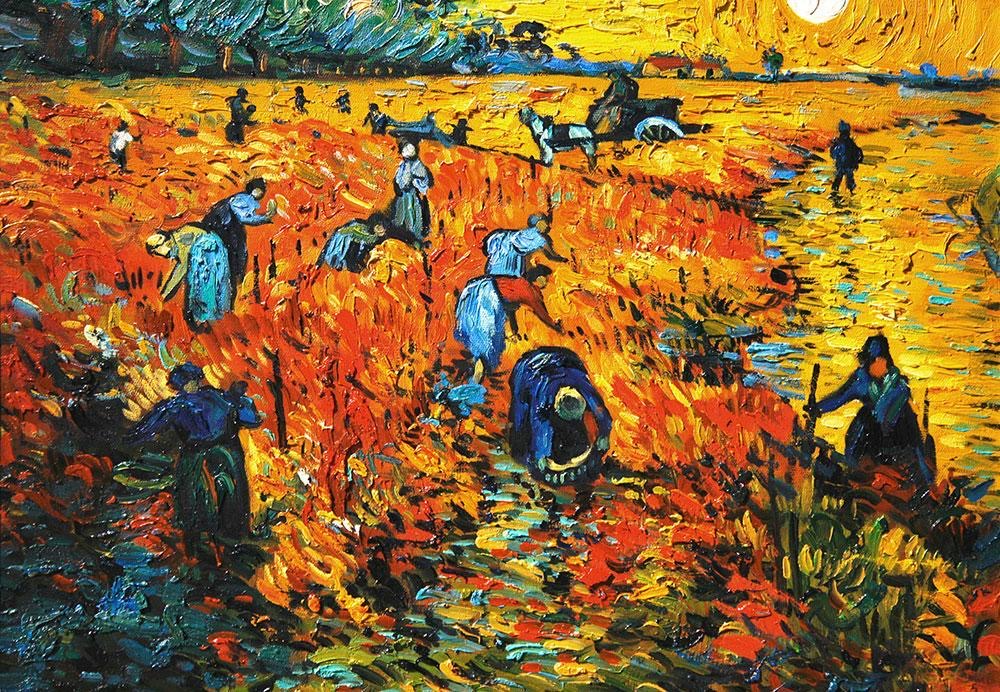
Throughout history, social and earthen balance, what Scripture calls shalom, have often been less valued than conquest and winning. We want more than and greater than…We want to be better and best and first- even if we are standing there alone.  Despite the theological beginnings of all persons made in the imago Dei, we subscribe to present social constructs and ideologies that say you win worth and achieve value. I love what artist Anna Strickland writes in regards to her painting below, which is based on this parable:
If we associate the vineyard owner with God, who chooses to pay all workers a daily wage no matter the hours they worked, this parable makes a strong case for a universal living wage. These workers are not seen as hours of labor, but as people. The hours they work may be different, but their needs are the same. And so the vineyard owner pays them, not according to their economic value, but their human worth...God’s grace is not given in measure to our economic value, our hard work, or our humility. It is given equally to all. 
While the pandemic has uncovered, in an abundance of spaces, the beauty of human resilience, compassion, and neighborly love, it has also underscored how tight our grip is on self preservation. This is the very foundation of our American capitalist economy. Mask wearing, which is among the most effective ways to protect neighbor in this pandemic, is protested as a violation of personal freedom.  Black Lives Matter declarations in the midst of rising police brutality against people of color are countered with the fragility of All Lives Matter. (Read: my [white] life matters). Political platforms continue to trumpet a return to an era of perceived greatness and (America) first-ness that exploited far more than protected. We (falsely) assume universal provisions, from healthcare to basic income, means the boots one person is wearing will be unstrapped from their feet and given to someone less deserving. We ignore the complex truth that many do not have access to boots while others have a closet full handed down to them from generations on end. 

We have a lot of work to do as a people in this land that is not our land. In the midst of our modern dystopian saga, one thing is also certain: as long as justice and fairness are polluted by competitive quests for first-ness and greatness, the fullness of God’s dreams for the world will remain elusive at best. It doesn’t have to be this way. There is a better and more inclusive way. This Way flips the script and reverses how we keep score. 

Actually, it doesn’t keep score at all. 

Everyone wins. 

The absurdity of God’s generosity is that there are no losers in the economy of God- only vineyards full of workers with equal share in the goodness to come from the Landowner. May this divine economy shape how we live and move and work AND VOTE in our earthly one.  

*Header Image, Red Vineyard in Arles by Vincent van Gogh, 1888. 

Friday, January 27, 2017

Beatitudes Remixed...Again


The Revised Common Lectionary can be quite providential. Only a week removed from the recent inauguration, when Jesus' preface to his sermon on the mount was read as part of the imperial liturgy, the same text pops up as the lection for preachers. 

And as I did nearly five years ago, here is my revised midrash of those whom Jesus called blessed, anointed, privileged, and at the forefront the inauguration of God's dreams for the world made new. These remixed beatitudes are upside-down prayers for these days whereby we reclaim the subversive nature of the biblical narrative written by those in the underbelly of empire. 
--------

Blessed are those whose spirits have been crushed by systems and institutions, who seek solidarity in the midst of darkness and despair, and those who hold onto hope by their finger tips, God’s dreams for the world include you.

Blessed are those whose grief runs deep and others who enter into the suffering of their most vulnerable neighbors, God’s comfort and peace extends to you.

Blessed are those who humbly extend love and kindness, the movers and shakers of this world who subvert narratives of power and privilege and yet your names may not appear in headlines or history books, you already know the joys of God's kingdom here and yet-to-come.

Blessed are those who long for the world to be made right, whose commitment to justice is the marrow in their bones, and who organize resistance movements against perpetuates of fear, hatred, prejudice, and abusive rhetoric that breeds oppression, for you will find validation in the good news that God is reconciling the whole world.

Blessed are those who offer second-chances, cultivate empathy, quest for greater understanding, error on the side of mercy and love, and dare to believe noone is beyond redemption, for you understand what it means to be whole and human.

Blessed are those motivated not by self-interest but by a concern for those frequently labeled "least" among us, who surrender the temptation for self-preservation and choose instead the good of the whole, for you have the eyes and ears of the Spirit. 

Blessed are those who choose peace over violence, love over vengeance, and grace over retaliation, who work towards the end of war, seek to heal the rifts in our neighborhoods, and labor tirelessly to ensure our schools and communities are made safe for our children, for you best reflect what it means to be called God’s people in the world.

Blessed are you who have linked arms with the oppressed, extended sanctuary to the refugee, protested violations of human rights as embodiments of prayer, and do all these things and more as extensions of a deep commitment to the Way of Jesus even at the risk of arrest and the threat to your very lives. You join the long history of prophetic witnesses and will find joy in the resurrection parade of the Messiah and the movement of this gospel.  

Saturday, October 22, 2016

His Name Is Zacchaeus and Mine Is, Too: Lectionary Reflections on Luke 18:9-14


From 1956 to 1964, Karl Barth preached among those incarcerated in Basel. In many ways, these sermons most faithfully capture the vast volumes of theology Barth wove throughout the twentieth century. At the center of each homily, which began with prayer and concluded with the Eucharist, was the confession that all of us stood in need of God’s grace. Here is where Barth found common ground with those he considered fellow congregants. 
“Has [God] really made things right for all of us? Even for the most miserable, the most afflicted and the most embittered of human beings? Yes! Even for the most grievous offenders? Yes! Even for the godless- or those pretending to be godless, as may be the case with some of your fellow-prisoners who declined to be with us this morning? Yes! Jesus Christ has made things right for them and for us all. He is willing to do it time and again” (Ascension Day 1956).* 
Barth recognized the mercy and grace of God were the great equalizers and levelers for all of humanity. In confession, he recognized each of us plays some part in the world gone rogue. The forgiveness of Christ then sets us free to view our neighbors, whether they are behind bars, a political debate podium, or this blogpost, through the lens of the gospel and God's promised reconciliation of all things. 

In Luke 18, Jesus illustrates a likely foundation for this theological and practical center through the contrasted prayers of a Pharisee and an unnamed tax collector. The piety of the Pharisee elevates the self at the expense of neighbor and constructs a faulty religious wall of ignorance, "God, I thank you that I am not like other people: thieves, rogues, adulterers, or even like this tax collector."

But he was just like them. And so are we.

So Jesus shares the contrasted prayer he may have personally heard from an unnamed tax collector, "God, be merciful to me a sinner." 

The humbled other confesses his need for God's intervention in the midst of human brokenness. The "sinner" confronts his participation in dysfunction only able to be remidied by the One whose mercy overcomes even the worst of human dealings or politics. The unnamed refuses to compare himself to his neighbors or to Caesar, who was at the helm of the corrupt socio-economic policies that underwrote his vocation. Instead, the unnamed confessor looks to be made right and whole so he can participate in a better economy and more just reign than that which has framed his lifework. 

If we have the eyes to see, the ears to hear, and jump a chapter over in Luke's gospel, we just may notice this tax collector “standing far off” has a name- Zacchaeus (Luke 19:1-10).  After much contemplation and confession, Zacchaeus has ventured from temple to tree, climbed down from his elevated perch, given reparations for his unjust and oppressive deeds (i.e. repents), and identified with the poor he once exploited. It is only after this sort of repentance that Jesus says salvation has come to this son of Abraham. Said differently, salvation in the economy of God happens in our concern for, identification with, and solidarity alongside the poor, oppressed, and neighbors on the margins. As Luke says elsewhere, "blessed are you who are poor…woe to you who are rich" (6:20,24); "some are last who will be first, and some are first who will be last" (13:30); "for all who exalt themselves will be humbled, but all who humble themselves will be exalted" (18:14). 

Zaccheus was only able to do this as he shifted his narrative from one of "us and them" and treatment of persons as collateral to one of solidarity with neighbor and those exploited by systems bent towards the rich. In a sense, his prayer in the temple was fully realized as he ventured to the streets of Jericho. Here he would find jubilee, reconciliation, and salvation. 

In the midst of the hostile rhetoric that consumes all arenas for public and personal discourse, the witness of Zacchaeus dares us to embrace a sobering narrative that binds us all together and see one another through the lens of God's mercy and grace. Zacchaeus' temple prayer combined with his offering of reparations in Jericho, point to salvation coming when we as the church, versus any presidential candidate, are willing to come down from our privileged perch in the tree and make amends with brokenness of the world we have allowed to happen.  After all, we are not only contributors to the fracturing of God’s world, but also paradoxical agents of wholeness, hope, and redemption. 

Each of us are mirrors of the sinner and saint whose name is Zacchaeus. 

This is likely what sent Karl Barth into the Basel prisons. 
May we make similar confessional journeys from sacred spaces to whatever cities, communities, neighborhoods, digital spaces, God calls us. May we do so aware we are all wrapped in the love and grace of Christ able to reconcile all things- even each of us. 

*Read the collection of these sermons in Deliverance to the Captives. The most pertinent sermon for this lectionary text would be the one delivered in September 1957, "All!"

Tuesday, June 3, 2014

A Beautiful Collision Here and Now: Life According to Trey (Part 2)

The youth were pretty upset when they found out I only wrote one part of Life According to Trey. They had so many questions and curiosities, more than I anticipated. So I left the beach a bit early and, while they prepped for dinner, I wrote Part 2. Enjoy, better said, be perplexed...

Trey was devastated, for sure, with what happened back in June. He was grateful the President, as a sort of consolation prize, invited him to a convention he was speaking at in a small town about 4 hours away.

But it wasn't his town. It wasn't his home.

Trey felt like he had missed his only opportunity to engage in a thoughtful and potentially critical conversation about his hopes and dreams, questions and concerns related to his community. Trey feared he would no longer be able to make the difference he had dreamed of for so long.

Dreams he had also kept hidden for far too long.

True, Trey had not been very active in the life of his church or volunteer and mission opportunities offered by the youth ministry. But that was only because he felt like they never really made any sort of difference. And being the introvert he was, he was never sure the youth pastor was interested in what he had to say.

Trey had always assumed the church and the youth mission trips were only about "spiritual" things.

Big churches like his own were only concerned about budget and butts. How many could we pack into this service, this trip, this program, this campaign, yada, yada...

Trey also had struggled with how people had reduced Jesus into a formula.

Trey once talked with one of the confirmation youth in the church, wait, maybe it was an elder, it doesn't matter. The point was, he asked one of them why they were a Christian and they said, because Jesus died for them so they could be forgiven of their sins and go to heaven when they die.

Seemed kind of boring in his mind. What's the point of the next 80 years if I am just living as though in a waiting room for the nurse to invite me into some pie-in-the sky, cloud-obsessed dwelling with naked angel babies playing harps.

Trey hated harps.

Trey also recalled when his grandmother passed away back in the fall. She wasn't that old, so not one of those, "she lived a good life" passings.

She was only in her 50s and died of an aneurism.

When the family was listed on the prayer chain, people would come up to him in good faith and tell him, "God was working for the good and had a plan."

"God was in control," they said, "and had let this happen for a reason."

Was the reason for his grandfather to quit Jesus? Because that's what happened. Trey feared, after this event, the same would happen to his father.

Trey feared it would happen to him. Would he quit Jesus, too?

It's not that he didn't believe God was there, but he doubted God "let this happen for a reason." Otherwise, God is a pretty lousy God. What good parent would let one of their children die, even ordain it to pass, so something else could happen for the benefit of another child?

Bogus, he thought.

Trey was laying on his bed, tossing a baseball up in the air, as he reflected on all that had happened this summer. He thought about his friends being away on a variety of service projects, youth retreats, and mission trips. Most he was not attending for a variety of reasons.

That's when the phone rang.

It was the youth pastor. She spoke with a sense of compassion that Trey had never heard before.

"Trey, I know you have been through a lot this past year. Baseball did not go the way you had planned, being cut from the sport you love. Your grandmother's passing, I can tell it still ways on you as it should. And while I am sure seeing the President was great, you were obviously burdened by what you have said was a missed opportunity by a simple misunderstanding of a letter. I am praying for you my friend, and want you to know we are here for you."

Trey didn't want to show too much emotion, but he felt the frog climbing up his throat and he fought back tears.

"Thanks, Hope. Really. Thanks."

"Trey," Hope replied. "I was wondering why you didn't sign up for our trip to Baltimore this summer? We'd love for you to come and a spot has recently opened up. Want to join?"
Trey began to share much about his concerns related to church, especially about how he never felt like what the trips were up to really made any difference. He even shared about why he was so frustrated about missing the dinner with the President.

"That was my chance to really make change happen. I came up with so many ideas."

Hope began to listen more and more, "Trey, we need you. The church is actually the very place for people like you to share your hopes and dreams. You don't need to wait for the President...or even a pastor. Youth are not only the future of the church, you are what God is doing now. Today. The Spirit is whispering, sometimes shouting, through teenagers who are passionate and view the world in a way many of us adults fail to notice. We need you. Now."

Trey had always thought Hope was like everyone else, but apparently not. She seemed to care about here and now, life on earth not only heaven. She even seemed to care about him. In fact, she said something he had never heard before.

"Trey, you have heard me say you are the temple of the Holy Spirit right? Do you know what that means?"

"Yea, I have heard that many times. Take care of your body and don't get tattoos, because you wouldn't spray paint the church."

"Seriously, that's what you have thought I meant? We need to get coffee sometime, I'll even show you my tattoo of 1 Peter 1:3-4 on my ankle...you may have never noticed."

Nope. That was a new one, Trey thought.

"Trey, you being a temple is a reminder that you are a mobile version of a collision between heaven and earth. The temple for God's people in ancient days was where heaven and earth met. The temple was like a miniature version of God's dreams for the world. It's where God dwelled. It was also originally a tent, and so it moved. That is, until God's people wanted to settle down and rival other nations and religions. So they turned it into a big building... "

"...kind of like what we have done with churches, right. Bigger is better?" Trey interjected.

"That's another conversation. But Jesus came into the world, as John says in his gospel, and templed among us- tabernacled actually. Jesus was the heaven-and-earth tent in human form. He came to show us what it could really look like. Then he invited us to be the same. That's why Paul wrote in 1 Corinthians 3:16, "do you not know that you are God's temple and that God's Spirit dwells in you?" That's why God's people and the church are on mission. We go places near and far pointing others to where God's kingdom is come, Gods will is being done, and where heaven and earth are colliding together. We follow Jesus as miniature movements of Gods dream for the world. I guess you can even say we practice now, in the present, what we believe to be true about God's promised future."

Trey's mind was racing. He had never heard it explained like this before.

"Hope, hold up...you are blowing my mind right now. I need a notebook...gotta write some of this down."

"Trey, why don't we go grab some coffee. I want to share more, but I really want to hear from you. I want you to teach me about how heaven and earth may be colliding in and through you. Where do you long for God's justice, peace, and renewal to bust into the here and now as we follow Jesus, not without our fair share of doubts, together."

Trey thought for a minute.

"Hope, could we grab coffee in Baltimore?"

Hope was confused a bit, "why not the Starbucks down the road?"

"I was thinking we could talk on the mission trip."

Hope chuckled a bit.

"Yes, Trey. That would be great."

Trey hung up the fun and resumed tossing the baseball up in the air. Then it came to him, maybe Hope's invitation was going to be even better than the one he received on June 20th?

So he hopped on the youth ministry's website and was sure to read all the paperwork more thoroughly than the letter he pulled out from the mail.

Trey wanted to make sure he knew where he was supposed to be this time.

Thoughts to Ponder
1. How does this story illustrate the significance of being God's temple? What does this mean for the mission of the church?
2. How does this story illustrate the role of youth in living out the mission of the church?
3. What are some of the hoeps and dreams you have for your neighborhood, local cities, and even other parts of the world? How may God be calling you to embody a beautiful collision of heaven and earth in these places?

Part 1: A Rare and Bold Invitation

Monday, June 2, 2014

A Rare and Bold Invitation: Life According to Trey (Part 1)

This weekend on the annual Beach Retreat, our youth engaged in conversations about heaven and earth. What I consider to be a perfect platform for contextualized eschatology with teenagers evolved into a weekend of storytelling and a rare attempt on my part to write a short tale.

What resulted was Life According to Trey, short stories of faith and doubt. I never imagined my youth would be so captivated and intrigued, adopting this fictitious character as though a member of the youth ministry. It even forced me to write Part 2 on the whim while they ate dinner. That will be posted tomorrow.

So, without further delay, meet Trey...

Trey lived in a small town just outside Washington, D.C. He was a junior at the local public high school and probably registered as ordinary according to the social standards of his peers. There was nothing about Trey that made him stand out or draw a crowd. Trey was cut from his JV baseball team as a freshman and so never tried out again. Many said he was smart, but B+ smart. So smart enough to keep his parents off his back but also only smart enough not to be invited to those end-of-semester breakfasts the principle held for all those on the honor role.

Trey also attended his youth group, but he was the quiet type. Trey participated enough to be known by name but apparently not enough to capture the attention of the youth pastor. He assumed this is why he was never asked to share his story at the local fundraising event. He often came home lamenting to his parents about how he wished the youth group would, maybe just once, recognize that you didn't have to be loud and out-going to be evidence of something good going on in your life or able to contribute interesting ideas.

Trey was not eager for attention, but also appreciated when someone acknowledged his existence. That's why he was so thrilled and stunned when he received a particular invitation. Trey's mother had asked he run down the drive-way and get the mail, sure to be mostly junk that would either be recycled or used as kindling next time his dad couldn't catch the match-n-light charcoal on fire.

But this time was different.

Trey opened the mailbox and, wedged between the grocery ads and the Community Courier, was cream-colored envelope addressed to him. The return address:

1600 Pennsylvania Avenue NW, Washington D.C. 20500.

On the reverse, the presidential seal.

It wasn't an election year. Trey was not old enough to vote. Trey was a B+ student and he had not even been active in too many service projects or volunteer opportunities. He was also certain his parent's were so jaded by politics that neither of them cast a ballot.

So why would the President send Trey a letter?

He walked into his house, ran up the stairs, and dismissed any and all questions from his mother about what he was up to. Trey shut the door behind him, sat at his desk chair, flicked on the lamp, and held the letter in his hand.

He knew he wanted to carefully open this letter so not to rip it. Trey expected a card, but instead it was a hand-written note. Trey doubted whether this was a legit letter, but then he kept seeing the seal:

Dear, Trey

I am making my rounds with some local teens and wanted to see if you would be willing to have dinner with me on June 20th at 6 p.m. I would love to have the chance to hear about your community, your family, your questions, concerns, hopes and dreams. If interested, please mail in the card included within this letter and we will see you then.

Sincerely,

The President of the United States

The President's left-handed, loopy signature just above the title confirmed this was a real letter.

Trey had not realized his hands were shaking, and so the card lay on the floor after falling from the envelope. He quickly filled out the card, not wasting a second with this rare invitation, and ran right back out to the mailbox and put up the red flag.

The next few weeks he told everyone he new about this incredible invitation. Trey shared about the greatest news ever to come to his mailbox. All his friends and family knew about June 20th at 6 p.m., so when that day came Trey had more than enough help getting himself ready for the occasion and the 35-minute ride to the White House. The family hopped in the car and headed to Pennsylvania Avenue, assuming they would know what to do once they pulled up to security.

They arrived right at 6 p.m. Nothing.

Paged the security guard. Their names were not on the list.

The President wasn't even there at the moment.

Then they received a phone call from their neighbor.

"Trey, the President and his entourage are here in our neighborhood. They said they sent you a letter and you confirmed your availability for dinner. They were wondering where you were. I told them you were in Washington. Has there been a mix up?"

Trey had been so eager about the invitation that he failed to recognize the letter was actually an invitation to dine at his home. The President wanted to sit at table in the rawness of his hometown. The President was willing to come to his place and, in his zeal, Trey had assumed he was supposed to head to the White House.

Trey thought the purpose all along was to leave his neighborhood and head to Washington, where he would be greeted with all sorts of flair.

This was more than a mix up, Trey thought. It was a confusion that could have been prevented had he actually read the letter.*

Thoughts to Ponder

How does Trey's story pertain to the way the church and Christians have frequently understood the goal of faith in Christ?

What about this story challenges your own discipleship and perceptions about what it means to be the church on mission?

What could have prevented Trey's blunder? How does this relate to the way many, maybe you, have read Scripture and the especially the New Testament?

N.T. Wright suggests the Apostle's Creed has played a role in our negligence of the life of Jesus Messiah and on-earth-as-in-heaven theology. How so?

What do you believe contributes to our neglect of God's kingdom already here and still to come?

Notes

*This story is an adaption and expansion of an illustration within N.T. Wright's, How God Became King. Wright suggests the popular assumption of the goal of Christianity as "going to heaven when we die" is "as though you were to get a letter from the president of the United States inviting himself to stay at your home, and in your excitement you misread it and assumed that he was inviting you to stay at the White House" (44). This is a fantastic read that challenges many on what Wright calls, "the forgotten story," which deeply affects the Church's theology and praxis of mission.

**The story above was embraced with so much enthusiasm on this past weekend's youth retreat, I had to write a second part on the whim while they ate dinner. Stay tuned tomorrow for more of Life According to Trey (Part II). The illustration was also crafted by a 9th grader while I told the story. Kind of fun, huh...

Wednesday, April 9, 2014

Noah Movie: The Most Faithful and Biblical Interpretation of the Ancient Myth?

If the church wants to learn how to get a generation of skeptics, cynics, and postmodern critics to engage the narratives of Scripture, I suggest we consult Darren Aronofsky and Ari Handel. The director and screen writer (respectively) of the recent box office smash, Noah, have reminded us flat and reductionist approaches to the Bible have grown tired only for the prophetic, existential imagination to be awakened by seasoned and novice readers alike.

The recent work of Aronofsky and Handel has also refreshed the ancient story and enabled one of the greatest and most familiar religious and cultural myths to jump off the pages of sacred texts with renewed energy and zest. Noah challenges viewers to surrender the great "arkey, arkey" of children's folklore and instead consider a wide variety of ecological, ethical, religious, and basic human questions provoked by the flood fable.

These are all good things. This is a very biblical shift, better said, return to how Scripture has been and maybe was originally read for generations.

So the best thing I can say in light of Noah, "thank you."

While Aronofsky has suggested this film is "the most unbiblical biblical film," his self-critique is an inaccurate overstatement. Instead, Noah is both an example of cinematic brilliance and Scriputural fidelity. This is not to say his Watchers, i.e. Nephilim gone ancient Transformers, or a stowe away descendant of Cain who attempts a mutiny onboard the ark are consistent with every jot and tittle of the Genesis motif.

They probably are not.

But the viewer is challenged not to be distracted by these directorial adaptations and expansions. On the contrary, we are invited to take notice of how Aronofsky has allowed the story to reside within his person and be birthed afresh as he not only retells the story but also brings the story to life.

That's exactly what Biblical stories were inspired to do from their earliest beginnings.

It's as though Aronofsky has joined a host of other great teachers and storytellers by crafting his own midrash of the biblical account.

The Bible and all related narratives were never intended as specimens awaiting dissection, formulas holding out for solution, or even rigid theological insights breading absolute certainty. The biblical narrative was and is a grand collection of illustrative questions to be engaged, wrestled, confronted, inherited, beheld, treasured, critiqued, contextualized, and awakened as God's living and active word to us and the whole world.

The Bible is ultimately to be practiced and reenacted.

Barth said it this way, “[The Bible] must not speak and think in the manner of a timeless Church discipline, but with full participation in the energies and hopes, the cares and struggles of the Church of its own age.”

Walsh and Middleton take it one step farther with what they term faithful improvisation:

"The church's praxis or 'performance' must be faithful to the thrust, momentum, and direction of the biblical story...But if our praxis is to be faithful to the story, this requires taking the risk of improvisation that is creative, innovative and flexible. It is important that our performance not simply repeat verbatim earlier passages from the biblical script. That would nnot be faithfulness for the simple reason that these earlier passages are not a script intended for our performance in a postmodern world but are the record or transcript of past performances of God's people. While we can see how our ancestors in the faith responded to God with varying degrees of faithfulness in a variety of circmstances, much of our difficulty in living as Christians today is that the concrete shape of our lives in the world is quite literally unscripted."

Truth Is Stranger Than It Used to Be: Biblical Faith in a Postmodern Age 183*

We have, for far too long, done violence to God's story and stories, scavenging them for this or that agenda or claim to modern certainty. We have forsaken the reality of the Bible as drama in favor of dogmatic idolatry.

We have dilluted the Bible in favor of more palatable and controllable document void of questions, ambiguity, paradox, and struggle about what God is really up to in the past, present, and future.

What Noah has done, and what many other readers and adherents to Scripture have been doing for years, is lift the text above these chaotic waters of modernity and liberate the sacred motifs as great conversation partners in practical and public theology discourse. The conversation: what do these stories mean for us TODAY as God's people who dwell within a world caught between beauty and devastation, good and evil, God's all-encompassing dreams and God's greatest despair.

What do stories like Noah reveal to us about present-day tensions between justice and mercy?

How do aged biblical stories like Noah propel us into faithful improvisation of the kingdom of God in the twenty-first century?

How do these epics confront our environmental and ethical consciences in the midst of so much negligence of both the earth and our most vulnerable neighbors around the globe?

What new questions does Noah raise in the here and now as we all wait for the return of Eden and God's new creation?

Aronofsky has received a large share of criticism for Noah, mostly from tweets, blogs, and pulpits of conservative Evangelicals who fear the director and screen writer have been unfaithful and unbiblical to such a beloved story hedged within a mere four chapters of the book of beginnings.

Actually, I think Noah's critics and all who have tamed this ancient epic may be the ones who have missed the boat.

But it's not too late to jump on board.

The world around us is already there.


A few questions raised for me by Noah:

How have we corrupted the world around us through our obsession with power, technology, convenience, and misappropriated quests to dominate creation versus care for and serve the world God made as good?

What would it mean if we began to foster intimacy with creation and valued every created thing as though it served a valuable purpose within God's world and ecosystem?

How can we begin to reclaim a sacred imagination that views the world as enchanted and interconnected versus static and serving all-purposes human? (See Bo Sanders below)

What do we make of God actually sending a flood to wipe out corrupt humanity? When we hear people use this rationale today we, rightly, reject such "natural" theology. Then there's this story. I would have, like Noah's family, wondered why we could not lower ropes to drowning victims. Further, I grieve how God's people today, myself included, often isolate ourselves from suffering that surround us on all sides.

How does the fatalist mentality of Noah, convinced God is finished with humanity altogether, leak into our own psyche and leave us cynical, jaded, and apathetic at best?

How are we any better today than the violent world that God wiped out ages ago? When will the violence of today be wiped out once and for all?

Should I be a vegetarian? If not, should I at least have a better awareness of where my food comes from and the life taken to nourish my body?

What seeds am I planting today that can be a part of Eden's return? How am I living out my responsibility and call as God's image bearer and caretaker of all God made?

What bitterness do I harbor, like Ham, that pushes me to isolate myself from others or wreak havoc as a means of self-preservation?

Where was Jesus in this film? (just kidding)

I could go on...


Related Resources

*Scripture as Missional Narrative

Podcast: Movie and Conversations with Aronofsky and Handel by Homebrewed Christianity

Noah: Inhabiting a ReEnchanted World by Bo Sanders

Noah: The Eclipse of the Biblical Narrative by Bo Sanders

Relevant Magazine: Movie Review

Noah: the Beautiful and the Haunting by J. Ryan Parker

Tuesday, February 11, 2014

Confronting Jesus: What Happened When the Messiah Encountered the Syrophoenician Woman

Was Jesus racist? Did the Messiah perpetuate stereotypes and prejudices of first-century Palestine?

Is it possible that Jesus had to be reconciled with his own neighbors before he could even begin to reconcile and redeem the whole world?

The writer of the Gospel of Mark thinks so.
"From there he set out and went away to the region of Tyre. He entered a house and did not want anyone to know he was there. Yet he could not escape notice, but a woman whose little daughter had an unclean spirit immediately heard about him, and she came and bowed down at his feet. Now the woman was a Gentile, of Syrophoenician origin. She begged him to cast the demon out of her daughter. He said to her, ‘Let the children be fed first, for it is not fair to take the children’s food and throw it to the dogs.’ But she answered him, ‘Sir, even the dogs under the table eat the children’s crumbs.’ Then he said to her, ‘For saying that, you may go—the demon has left your daughter.’ So she went home, found the child lying on the bed, and the demon gone." (Mark 7:24-30)
I am not sure I have ever heard a sermon, let alone a Bible study, on this text. I am quite certain this has never been engaged in youth ministry circles or preached at youth retreats I have attended.*

I know I have often glossed over this story, simply dismissing the awkwardness as though what was happening in this little tale was not really one of the most significant encounters in all of the gospels. I treated these seven verses as though they were not really as complex and border-line offensive, especially to those who first read them aloud.

I blame this on the reality that we do not like it when our Jesus calls a woman a "dog," similar to a variety of racially charged and slang terms we still toss around in the 21st century, and initially refuses to heal her little girl because of ethnicity.

Mark 7 flies in the face of all we have been taught about Jesus' love for all people, especially little children. So we don'd dare discuss this text. Yet, we should be put off when we read this story. If we are not, Mark would challenge us, have you really been listening to my gospel at all?

Mark 7 proposes, rather audaciously, the greatest news of all the gospels: all will be delivered and made whole just like this foreign mama's little girl. The good news of the kingdom of God, inaugurated by the life, death, and resurrection of Jesus, is for the whole world. The gospel is not only for the children of Israel, believing Israel, the modern church, or all those who profess a particular brand of Christian theology labeled true and biblical.

The good news of what God has done and is doing in and through Jesus Messiah is for the whole world. Syrophoenician women included. This blogger included. My Hindu neighbor down the road and across the ocean included.

This is something even Jesus apparently had to learn. After all, he was growing in wisdom and stature. You could say Jesus was challenged to rethink his mission and invite those who were used to picking at the scraps beneath the table to sit at more prominent positions around the table.

Maybe that's why Mark's next major pericope is another, albeit different, feeding story. Mark 6, five loaves to feed four-thousand, leaving twelve baskets of left overs. Five. Twelve. The Jewish story satisfied.** Mark 8, seven loaves for four-thousand, leaving seven baskets of left overs. Seven. Perfection. Completeness. The Gentile and whole world's story satisfied.

"Do you not yet understand?" (Mark 8:21)

And in between the feedings is a determined mother who doesn't give two rips about ethnicity or gender or the Hebrew Scriptures. She simply has a sick daughter who needs healing and is bent on Jesus being the difference maker. So she confronts Jesus' own racism, elitism, and exclusionary kingdom.

And her persistence pays off. Like Moses in the desert, changing the mind of God, Jesus is transformed and the gospel breaks open for her little girl and all those so used to being pushed aside by any religious story or socio-political system.
"This woman- marginalized by race, gender, and class- taught Jesus something about the inclusivity of God's realm. Jesus comes to see more fully the radical inclusivity of the gospel he proclaims through the trust and daring of this woman. He is moved from the social norms o first-century Mediterranean 'honor culture' that limited his vision and compassion. He is moved from a stance of excluding to one of including." (Ched Myers, "Say to This Mountain": Mark's Story of Discipleship, 84)
This Messianic move all started with a Syrophoenician woman's courage to confront.

So I wonder, what about the Jesus story do we need to confront? What about the witness of the gospel do we need to challenge? What about the mission of the church do we need to reimagine and broaden for the sake of our most vulnerable neighbors?
What does the kingdom really mean in the wake of pervasive poverty that cannot possibly be a part of God's plan? 
What does the good news mean for the gay community, who are so frequently relegated to the fringe or forced to sit in silence in our congregations?
What does the gospel look like for teenagers who fear walking down their hallways, uncertain who may be lurking around the corner?
What does God's dreams for the world look like in the midst of economic inequality and sexist pay scales?
What does the Messianic message mean for homeless veterans, unjust wars, illegal immigrants, dysfunctional school districts, on-going genocide, uninsured persons, or even who is granted access to pulpit, pew, or platform in a variety of religious and political conversations?
How does Mark's story of deliverance and salvation pertain to our own understandings of who is in and who is out both before and after the grave? How does the persistence of the Syrophoenician woman confront our own theologies of resurrection, eternity, and the scope of God's grace in the age to come?
I am not sure. I know I do not fully understand.

I also know that we all need confrontations here and again.

I also pray we all have the courage to confront when even the most sacred seems so desperately wrong.


*This past week we taught this story with high school youth using the Re:form: Ancestors Curriculum. Be sure to check it out: http://reform.wearesparkhouse.org/
**Many believe "five" referred to the Pentateuch, i.e. first five books of Hebrew Scriptures, and "twelve" referred to the tribes of Israel. Seven is an ancient, and still today, number of completion and wholeness. This may be the origins of "lucky number 7."