Sunday, December 6, 2020
Speak: #AdventWord Day 8
Friday, December 20, 2019
Go: #AdventWord Day 20
Friday, December 6, 2019
House: #AdventWord Day 6
Our kids love to play house. This Thanksgiving, they especially loved it when they smooshed inside my sister’s outdoor playhouse complete with a loft, which would make a perfect location for a camp out. For them, to play house is to leverage their imagination and mirror what they love about our family and home life. Sure, it may also be their opportunity to do things the way they wish we did as their parents or rehearse schemes to overthrow mom and dad. But in the end, a large reason they like to play house is because theirs is safe. Tragically, the same cannot be said of all children.
On this Feast of St. Nicholas Day, I am reminded of an ancient story about home. In Myra, pirates had raided the village. As they fled with their stolen goods, they abducted a young boy, Basilios, who was made a cupbearer of the Cretan ruler. A year later, Basilios’ mother retreated to her house and prayed for Saint Nicholas, who was also the deceased bishop of her town, to protect her only child. That same moment, story goes Basilios was questioned by the ruler about his downcast spirit. He replied, “I’m thinking of home and the special feast day of St. Nicholas.” That is when the ghost of St. Nicholas lifted the boy by the hair, out of the possession of his abductor, and returned him home.
Today, I am lifting prayers for children in search of home. I pray for kids who live in violent homes, others who bounce from foster home to foster home, young ones who migrate from oppressive, corrupt, and war-torn nations, modern-day youth ripped away from their homes and trafficked for horrific purposes. I pray, also, for those parents who long for their children to return home. Then I pray each of us would dare to have the faithful imagination to ensure all children one day have a home.
Read more of my favorite St. Nick reflections here or on the label below:
https://gregklimovitz.blogspot.com/2014/12/st-nicholas-would-sandal-slap-santa.html?m=1
Thursday, December 10, 2015
What If St. Nicholas Really Did Come to Our Town? Keeping Advent Eyes Open in a Tired World
Tuesday, December 2, 2014
St. Nicholas Would Sandal Slap Santa: Ancient Bishop as Advocate for Children, Victims of Human Trafficking, and Wrongly Accused on Death Row
There's a legend about St. Nicholas that many fanatics of Early Christians desperately want to be true.
The story goes that Nicholas and Arius were among many at the Council of Nicaea in the midst of a heated theological debate about the nature of God. That's when Nicholas grabbed a brick, lifted it up, and declared that as the brick was one substance in three parts, i.e. earth, fire, and water, so also was God one substance (homoousios) made up of three parts. Father. Son. Holy Spirit. The brick then burst into flames, vanished from their site, and left only water to drip from Nicholas' hands and onto the floor.
Arius, on the other hand, was a gifted orator* and began to spit rhymes about how Jesus was not fully divine. Christ was actually not of the same substance as God the Father but had a created beginning. I like to think that after his rhythmic rhetoric, Arius dropped his mic, shook the dust from his shoulders, winked at his counterparts, and stepped aside in challenge.
St. Nicholas wanted nothing to do with this blasphemous, albeit popular and catchy, theological beat. So the Bishop of Myra stood up, took off his crusty sandal, and slapped the would-be heretic across the face.
That's right, St. Nick sandal slapped his theological opponent. So much for being jolly.
It's not known whether St. Nicholas was even at the Council of Nicaea and unlikely that his nemesis Arius was even invited, as he was not a bishop and would have had to send representation. Still, the story gives hints and guesses to the pure passion of the man who would be morphed into a Coca-Cola ad campaign of the 1930's and the foundation for consumer-driven Christmas, long lists that keep places like Macy's, Walmart, and Amazon.com in business, and the parental threat that runs a muck this time of year- better be good, Santa's watching.
Needless to say, anytime I pass by a makeshift North Pole in a shopping mall I pause and think, would St. Nicholas sandal slap the bearded icon and all nine of his reindeer? I wonder if Nicholas would do the same to Santa Claus as he supposedly did to Arius, counting Claus as some sort of blasphemous and offensive distortion of who he was and all he aspired to be as a disciple of Jesus and leader in Christ's church.
Sure, there is much to like about Santa. Maybe the old fella encourages the imaginations of children and playful generosity of parents. It's possible that Santa is a fun folklore to hand down to each generation, fostering a spirit of mystery and anticipation common to the season.
It's also possible that Santa has overshadowed the more brilliant stories that were told for generations before soda companies and capitalism got hold of him.
Stories like the time when St. Nicholas rescued three women about to be sold by their father into an ancient human trafficking ring.
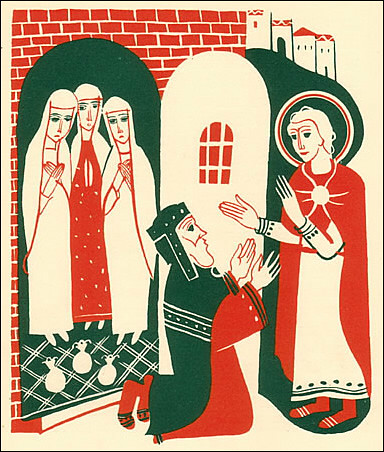
The family had run out of money and found themselves uncertain about how to live another day. The only option the father felt he had was to sell off his young girls into prostitution. Bishop Nicholas got word and on two separate occasions anonymously tossed bags of money into an open window. The money, which came from Nicholas' inheritance, was enough to pay the dowry needed to be wed and prevent them from captivity and the horrors of prostitution.
But there was still one more daughter. And the father was determined to find out the identity of this mysterious donor. As the father camped out on the roof of his home he saw Nicholas dropping a bag of money down their chimney and into a sock hung out to dry.
Chimney.
Stocking.
Rooftop.
Anyway, caught red-handed, Nicholas made the man promise to protect his identity and refrain from revealing who had provided such elaborate funds. Thus the beginning of the mystery behind the man with a beard and red mitre.
Yet the story was too good not to be told. The prophetic and radical generosity of those who benefited from and followed behind the secret graces of Nicholas even birthed new legends.
There's the story of those wrongly accused of a crime and sentenced to death by beheading. Just as the sword was about to come down, Nicholas intervened, seized the downward thrusting sword in his calloused hand, halted their execution, and played a pivotal role in accusations being expunged.
There's the tale of two parents whose enslaved child was lifted by his hair out of the courts of an oppressive ruler and returned to his mother and father by the spirit of the deceased Saint Nicholas.
It can be said that Nicholas was one of the earliest advocates of victims of child labor and slavery, human trafficking, and those wrongly accused who sit on death row.
A far cry from what has become to be known as Santa Claus.
As we approach December 6th and the Feast of St. Nicholas, may we pay homage to the faithful witness and man behind the myth. May we tell our children these sacred stories of justice, advocacy, intervention, concern for the poor, and desire to give mysteriously more than receive abundantly.
Maybe then we will begin to tap into the true Spirit of Christmas, which neither involves sandal slapping our theological opponents nor trampling those in front of us in the lines at your local retail store.
Happy Feast of St. Nicholas.
Related
*"Arius' views were all the more popular because he combined an eloquent preaching style with a flair for public relations. In the opening stages of the conflict, he put ideas into jingles, which set to simple tunes like a radio commercial, were being sung by the dock-workers, the street-hawkers, and the school children of the city" (Bruce Shelley, Church History in Plain Language 100-101).
See Pete Enns Post, St. Nicholas: What Can I Say, He Was a Beast
The Man Who Would Be Santa Claus by Adam C. English
Thursday, December 12, 2013
Santa Wasn't White, Neither Was St. Nicholas or Jesus of Nazareth
Thanks, Fox News, for yet another reason not to tune in to your station and instead wait for your clips to pop up on my twitter feeds and in Facebook messages from friends. Thanks for yet another bit to use with youth and adults alike when discussing how our nation still wrestles with racism and deep-seeded bigotry.
Thanks for the clip that will certainly be used in a class I will facilitate this Sunday, "Santa's Real: The Man Behind the Myth."
But just in case nobody has yet to point out to you or your viewers:
1. Santa was not white. St. Nicholas was likeley Mediterranean and/or Middle Eastern. Nicholas of Myra looked nothing like me nor any of your homegenous panelists. So, for all you kids and Fox News show hosts, Santa just wasn't white. Coca-Cola's version may be, but the great Wonderworker of the fourth century- not likely. Just wanted to get that out there.
2. Jesus, also, was not white. Jesus was Palestinean Jew. In case you were wondering, that's not the same thing. I know we prefer to craft Jesus in our own image in efforts to leverage our agenda and privilege, but Jesus was born into an oppressed class of marginalized peasants. So maybe we should tilt our concern towards the same people groups as well.
3. Nicholas was not a Greek bishop. Nicholas was born in the latter portion of the third century C.E. in Patara, nearby Ephesus and situated within Asia Minor or modern day Turkey (see point 1). Also, St. Nick was a revolutionary, justice-seeking, philanthropical bishop of Myra. Again, not in Greece but Asia Minor during the peek of the Roman Empire.
4. Making Santa an inclusive holiday figure is not exactly a bad thing. The panelist you tried to squeeze out was actually on to something: the legend of St. Nicholas is elastic and our culture can handle diverse representations. In fact, this may be a great attempt to honor the late Bishop of Myra. If pain and isolation is caused to young kids because the cultural icon does not look like them, our greatest humanitarian and charitable deed may be to draw out St. Nick's alternative skin tone. Again, the Bishop probably had a darker complexion anyway.
5. The one thing you got right, Santa Claus is not a penguin because, as you eloquently stated, the birds can neither fly nor lug around all those gifts around the world. But your white Santa, now that's apparently another story.
Blessed Advent and May All Your Christmases be, well, welcoming to all God's people- especially the poor, oppresed, and any wrestling with deep and real pain.
Recommended Reads and Related Resources:
- Article referred to by Aisha Harris, Santa Claus Should Not Be White Anymore. I do not subscribe to Harris' "Penguin Claus" proposition, but I wonder if this is more satire and tongue-in-cheek that Fox missed. Regardless, her points are fair and worth pondering over with greater felxibility and humility than what was offered by Fox.
- Click Here for Handout for "Santa's Real: The Man Behind the Myth"
- www.stnicholascenter.org
- www.saintwhowouldbesanta.com
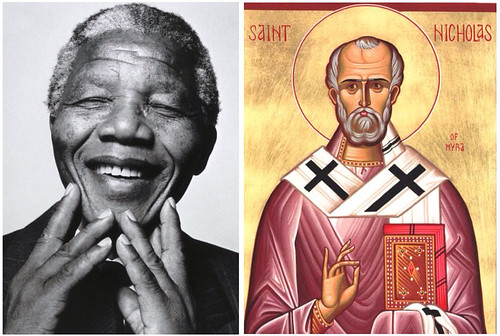
- Previous Blogpost with more links, Celebrating Nelson Mandela on Feast of St. Nicholas
- Above image is of the legend of St. Nicholas delivering three young women from being sold into prostituion due to their father's bankruptcy. The kneeling figure is the father expressing gratitude for Nicholas generous offerings that, legend has, were thrown through his window and landed in the daughters' stockings hung up to dry. See St. Nicholas Center website for other images.
Thursday, December 5, 2013
Celebrating Nelson Mandela on the Feast of St. Nicholas
I was dreaming up a blogpost on the legends and myths of St. Nicholas when I heard the news of the death of Nelson Mandela. I was eager to write a few reflections titled, "Santa's Real: The Man Behind the Myth," when I learned of the South African freedom fighter's passing from this life into life eternal. Mandela's long walk to freedom had finally reached the end. Better said, Mandela entered God's great liberation that will one day behold us all.
I am no Mandela scholar. I am a novice when it comes to the history of South Africa and the struggles with apartheid. I was ten when he took office and vaguely remember watching his inaugural address on t.v. in history class. While his autobiography, A Long Road to Freedom, is at the top of my list of all time favorites, I would have to google quotes for this post.
But we don't need the writings of a saint, letters of a hero, or verbatims of revolutionaries in order to be moved and shaped by their legacy. Their lives and witness take on a spirit of their own, influencing generation after generation to live into the same ethics and virtues of these icons of faith, justice, and commitment to the common good.
So as I sit hear drinking my coffee on December 6th, a date marked for the Feast of St. Nicholas, I find it fitting to do so with a streaming of tributes to Mandela in the background. Afterall, the fourth-century bishop of Myra and our generation's greatest patron to justice and reconciliation hold much in common.
There are stories of St. Nick secretly liberating three young women from being sold into prostitution by their father, who was on the brink of poverty. Tossing bags of currency through down chimneys and windows, which landed in the middle of dinner tables and even a sock hung up to dry, St. Nick looked for secret and subtle means to set captives free. He was, in a way, one of the earliest advocates against human trafficking.
While Mandela was the oppressed fighting for liberation, St. Nick used his privilege to do the same. St. Nick, who came from a wealthy family, leveraged his status and protested corrupt empires, politicked against unjust taxation, interrupted the executions of the innocent, struck down oppressive idolatry, and advocated for children near and far. The saint who would be co-opted by Coca-Cola commercialization and mutated into Santa Claus, was more than jolly. Nicholas of Myra was a religious and social revolutionary who was fueled by far more than milk and cookies.
"More than public charity or personal purity, Nicholas devoted himself to justice, to righting wrongs and correcting inequities. These were the concerns that characterized his life. He was more than a public defender of course; he was a minister of God." (Adam Engish, The Saint Who Would Be Santa, p. 79)
And like Mandela, Nicholas spent time in prison. It seems most advocates of God's dreams for the world do.
I have to get me a record.
People have often asked if Amber and I are going to play Santa Claus with our kids.
The jury is still out.
We want our kids more versed in the legends and praxis of St. Nick than the over-commercialized icon of materialism.
We don't want the revolution to die.
And when I consider that my kids will never see Mandela live on t.v., I want to make sure they learn stories of this twentieth and twenty-first century saint, too.
So we are going to have to tell them all kinds of stories. We are going to have to embrace a variety of traditions and maybe craft a few of our own. If we want the revolution of love, justice, and peace to be embraced by our children, we must tell the tales and leverage the legacies of heroes and sheroes of the faith.
There are plenty of tales and legends to tell.
Happy St. Nicholas Day.
And by the way, Mandela Day is July 18th.
Resources:
The Saint Who Would Be Santa Claus by Adam C. English (www.saintwhowouldbesanta.com)
Blogpost with Adam English and link to an excellent podcast about hardcore St. Nick: http://homebrewedchristianity.com/2013/12/02/whips-and-sticks-and-good-music-st-nick-has-it-all/
The Saint behind Santa Claus: http://www.relevantmagazine.com/god/church/features/23886-the-saint-behind-santa-claus
Nelson Mandela: Dreamer of Big Dreams: http://www.pcusa.org/news/2013/12/5/nelson-mandela-dreamer-big-dreams/
Mandela quote above pulled from Kristen Howerton's Facebook page. Check out her blog: www.rageagainsttheminivan.com
Monday, February 25, 2013
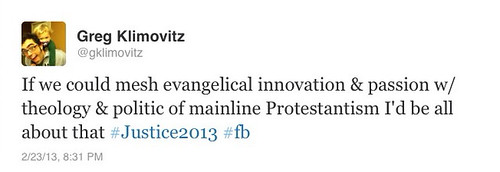
Justice Conference 2013: Evangelical Contribution to a Trending Yet Significant Movement
Is that what justice is for Evangelicals? Is it a trending passion and hipster movement that is here today and gone tomorrow? As pondered by Gary Haugen of IJM, will the causes and voices crying for advocacy be rolled in and out much like the varying conference frills wheeled in and out of the Philadelphia Convention Center?
While I still wonder, jaded by past experiences with evangelical congregations and popular voices who rejected justice then jumped on board just before the world around them passed them by, I was encouraged by those who challenged this real temptation of trend. Evangelicals in Philly confessed their past ignorance and gathered together for repentance as they turned towards a broader and much more wholistic gospel.
Brenda Salter McNeil preached, "We don't have an evangelical theology that can address the catastrophic events of the day. We need a new theology. How can we share with the world what is happening when we don't know ourselves?"
Agreed.
Yet, while Evangelicals struggle to develop a theology of justice with great depth, the innovation, creativity, and praxis are worthy of celebration and replication. Although not a competition, their efforts trump the tangible responses of many mainline denominations who have the rich tradition and deep theology of justice but slow and red-tape laden responses to human suffering and missional engagement. Brenda Salter McNeil again exposes truth:
As a mainliner who is only now beginning to recover my relationship with evangelicalism, I envy the ability to act quickly and respond intuitively. You do not have the same institutional barriers we do. You do not obsess over polity and cling to stale patterns and systems. While you and I may disagree vehemently on the ins and outs of theology and doctrine, when God calls you respond. I am grateful that you do! I also hope we can collaborate together with greater frequency. We actually hold more in common than we may realize or care to admit."We have an idolatrous posture towards injustice and real human suffering. Our obsession with theological and political rationale can stunt compassion and empathy."
They needed those who were doing more than speaking about justice, but also and especially doing justice, loving mercy, and walking humbly with God.
Viewed in that light, the conference was a major success, even if it was trending.
And I got to meet John Perkins. I was also introduced to Micah Bournes (spoken word below).
So thank you @justiceconference2013. I am grateful for the weekend break from main-line protestantism and fresh conversations with sisters and brothers living what I dream to practice sooner rather than later!
**Suggestion for 2014:
*How can we reframe how all of this pertains to youth ministry and those packaged short-term mission programs for summer youth ministry that perpetuate the non-profit industrial complex mentioned by Eugene Cho. But that's for another day.
**There was a void in engagement with LGBTQ justice issues. Really should invite PFLAG and Jay Bakker.
-------------
Here are a few notes from the conference for those interested. These notes do not assume I agree with all :)
Wednesday, November 28, 2012
Wait, Advent's Here Already? A Few Helpful Resources for the Liturgical Season
Advent reminds us that, despite all evidence to the contrary, God is indeed among us, with us, for us, and before us. We can confess this because God came as one of us.
Karl Barth says it best,
"But is Christ in us? Is Christ even in present-day society? We hesitate to answer and we know why we hesitate....But if Christ is in us, then society, in spite of its being on the wrong course, is not forsaken of God. The 'image of the invisible God,' the 'firstborn of every creature' in us (Col. 1:15), indicates a goal and a future...So: we bid you hope" (The Word of God and The Word of Man 274-275).The first Advent reminds us to hold on hope for the second Advent, when Christ will come again and make all things new. Our encounter with Advent awakens us to live into this future hope in our ever-day present.
"Advent is also a pilgrimage. A time of sacred travel. It is a way that we answer what Goethe called "the holy longing." During Advent we will leave the place of our birth to journey to the birthplace of another. It is an invitation to be born again." (Rose Marie Berg)Advent is also a unique opportunity to engage in creative and comtemplative expressions of holy ritual. Whether it be lighting and Advent wreath on Sunday mornings and each night at dinner, reading a particular devotional each evening before bed, or listening to favorite seasonal music, the formative traditions of Advent must not be bypassed. They are playful yet sacred reminders of who we are as the pilgrim people of God.
That said, I thought I would share a few of my favorite Advent practices that guide me to December 25th.
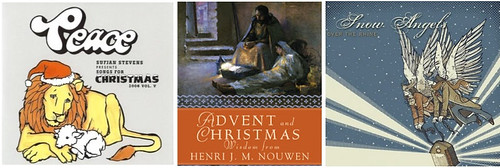
Christmas Albums
Songs for Christmas by Sufjan Stevens (any of the volumes or sing-along are good!)
Snow Angel by Over the Rhine (free on noisetrade.com)
Advent Songs by Sojourn
Christmas Songs by Jars of Clay
Devotionals/Spiritual Disciplines
Preparing for Christmas with Richard Rohr: Daily Meditations for Advent
Advent and Christmas: Wisdom from Henri J.M. Nouwen
Divine Hours: Prayers for Autumn and Wintertime by Phyllis Tickle (section for Advent)
Daily Readings for Advent 2012 (Revised Common Lectionary & PCUSA Book of Common Worship)
Non-Traditional Advent Songs and Dinner-Table Reflection Discussion Starters
Alternative Giving
Ideas for Reclaiming Advent and Christmas (PCUSA Just Living)
Advent Conspiracy: www.adventconspiracy.org
Other Interesting Seasonal Reads/Listens
It's Not Christmas Yet by Rob Bell (Relevant Magazine)
Advent TNT Extravaganza (Homebrewed Christianity Podcast)
Advent in a Crumbling Empire by Shelley Douglass (sojo.net)
The Habit of Advent by Rose Marie Berg (sojo.net)
Top 10 Resources for Advent 2012 (sojo.net)
www.stnicholascenter.org
St. Nicholas Wasn't White and Other Thoughts on the Bishop of Myra