Friday, February 25, 2022
Locutions: Words When Everything Else Fails Us
Sunday, April 19, 2020
Thomas' Unless Is Ours, Too: Looking for Resurrection with One Eye Open
Monday, January 6, 2020
Epiphany: Looking for Stars of Hope in (Un)Common Places and People
[God’s] appeals come through the conversations of good people, or from sermons, or through the reading of good books, and there are many other ways, of which you have heard, in which God calls is. Or they come through sicknesses and trials, or by means of truths which God teaches us at times when we engaged in prayer; however feeble such prayers may be, God values them highly (Interior Castle, p. 24-25).
Tuesday, December 10, 2019
Grace: #AdventWord Day 10
This is a bit what grace has looked like for us over the last 11 years. Our now aged and tired #beagle, whom we rescued when he was two-and-a-half years old, has transformed from an anxious and skiddish pup to a gentle, kind, and gracious companion. When finances are tight, Jax models trust in daily provision. When the stresses of every day push us to the edge, he walks the neighborhood with us as we blow off steam. Jax was an early running partner when a lone mile was my max- and his, too. Jax’ fur absorbs our tears and his snout rests on our lap when we need that assurance we are not alone. In the midst of our deepest longings for children, Jax provided presence when we knew mostly emptiness. On the other side, our kids now count him as one of their (much older) siblings, extending grace to us as he no long gets prime attention. Animals can be, without question, agents of divine grace. St. Francis of Assisi, patron saint of animals and ecology, especially considered dogs part of his faith community. “You call it a sin that I love the dog above all else,” I recently saw Francis attributed with asking. “The dog stayed with me in the storm, the man not even in the wind.” On this eleventh day of Advent, I am giving thanks for the grace of my dog who has been with us in and out of life’s storms. I am also grateful for the opportunity we have had to live into grace as we have provided a safe home and family for him for more than a decade.
----
This reminded me of an old post, that time I adopted a squirrel :)
Friday, December 6, 2019
House: #AdventWord Day 6
Our kids love to play house. This Thanksgiving, they especially loved it when they smooshed inside my sister’s outdoor playhouse complete with a loft, which would make a perfect location for a camp out. For them, to play house is to leverage their imagination and mirror what they love about our family and home life. Sure, it may also be their opportunity to do things the way they wish we did as their parents or rehearse schemes to overthrow mom and dad. But in the end, a large reason they like to play house is because theirs is safe. Tragically, the same cannot be said of all children.
On this Feast of St. Nicholas Day, I am reminded of an ancient story about home. In Myra, pirates had raided the village. As they fled with their stolen goods, they abducted a young boy, Basilios, who was made a cupbearer of the Cretan ruler. A year later, Basilios’ mother retreated to her house and prayed for Saint Nicholas, who was also the deceased bishop of her town, to protect her only child. That same moment, story goes Basilios was questioned by the ruler about his downcast spirit. He replied, “I’m thinking of home and the special feast day of St. Nicholas.” That is when the ghost of St. Nicholas lifted the boy by the hair, out of the possession of his abductor, and returned him home.
Today, I am lifting prayers for children in search of home. I pray for kids who live in violent homes, others who bounce from foster home to foster home, young ones who migrate from oppressive, corrupt, and war-torn nations, modern-day youth ripped away from their homes and trafficked for horrific purposes. I pray, also, for those parents who long for their children to return home. Then I pray each of us would dare to have the faithful imagination to ensure all children one day have a home.
Read more of my favorite St. Nick reflections here or on the label below:
https://gregklimovitz.blogspot.com/2014/12/st-nicholas-would-sandal-slap-santa.html?m=1
Thursday, September 28, 2017
On Challenging Sacred Symbols in Church and Society: A Word for World Communion Sunday
“You call me Teacher and Lord- and you are right, for that is what I am. So if I, your Lord and Teacher, have washed your feet, you also ought to was one another’s feet. For I have set you an example, that you should do as I have done to you…” (John 13:13-15).
“Jesus said, ‘Make the people sit down.’ Now there was a great deal of grass in the place; so they sat down, about five thousand in all. Then Jesus took the loaves, and when he had given thanks, he distributed them to those who were seated; so also the fish, as much as they wanted. When they were satisfied, he told his disciples, ‘Gather up the fragments left over, so that nothing may be lost.’” (John 6:10-12).
*In this year when we celebrate the 500th Anniversary of the Protestant Reformation, this also includes the church as (oppressive) institution. Thanks Martin Luther!
Friday, May 13, 2016
Pentecost and Presbyterians: We are literally in the story...
“‘And in the end of days it will be, God says,that I will pour out my Spirit upon all flesh, and your sons and your daughters will prophesy,and your youth will see visions, and your elders will dream dreams.’” (Acts 2:17 translation mine)
Thursday, December 10, 2015
What If St. Nicholas Really Did Come to Our Town? Keeping Advent Eyes Open in a Tired World
Monday, August 24, 2015
Technology as Sacramental: A Means of Grace, Prophetic Witness, and Community Formation
technology, n. the mediums and/or tools used to apply knowledge of something [or someone] of significance for real and practical purposes.
----------
Theology of Technology, Media, and Ministry (Slideshare Presentation: http://www.slideshare.net/gregklimovitz/technology-and-ministry-54307946)
A great resource:
The Digital Cathedral: Networked Ministry in a Wireless World by Keith Anderson
*"We cannot celebrate and receive the sacrament ordained by [God] without looking beyond the sacrament as such and finding [God] in the sacrament" (Karl Barth, Church Dogmatics II.1 p. 50).
Tuesday, December 2, 2014
St. Nicholas Would Sandal Slap Santa: Ancient Bishop as Advocate for Children, Victims of Human Trafficking, and Wrongly Accused on Death Row
There's a legend about St. Nicholas that many fanatics of Early Christians desperately want to be true.
The story goes that Nicholas and Arius were among many at the Council of Nicaea in the midst of a heated theological debate about the nature of God. That's when Nicholas grabbed a brick, lifted it up, and declared that as the brick was one substance in three parts, i.e. earth, fire, and water, so also was God one substance (homoousios) made up of three parts. Father. Son. Holy Spirit. The brick then burst into flames, vanished from their site, and left only water to drip from Nicholas' hands and onto the floor.
Arius, on the other hand, was a gifted orator* and began to spit rhymes about how Jesus was not fully divine. Christ was actually not of the same substance as God the Father but had a created beginning. I like to think that after his rhythmic rhetoric, Arius dropped his mic, shook the dust from his shoulders, winked at his counterparts, and stepped aside in challenge.
St. Nicholas wanted nothing to do with this blasphemous, albeit popular and catchy, theological beat. So the Bishop of Myra stood up, took off his crusty sandal, and slapped the would-be heretic across the face.
That's right, St. Nick sandal slapped his theological opponent. So much for being jolly.
It's not known whether St. Nicholas was even at the Council of Nicaea and unlikely that his nemesis Arius was even invited, as he was not a bishop and would have had to send representation. Still, the story gives hints and guesses to the pure passion of the man who would be morphed into a Coca-Cola ad campaign of the 1930's and the foundation for consumer-driven Christmas, long lists that keep places like Macy's, Walmart, and Amazon.com in business, and the parental threat that runs a muck this time of year- better be good, Santa's watching.
Needless to say, anytime I pass by a makeshift North Pole in a shopping mall I pause and think, would St. Nicholas sandal slap the bearded icon and all nine of his reindeer? I wonder if Nicholas would do the same to Santa Claus as he supposedly did to Arius, counting Claus as some sort of blasphemous and offensive distortion of who he was and all he aspired to be as a disciple of Jesus and leader in Christ's church.
Sure, there is much to like about Santa. Maybe the old fella encourages the imaginations of children and playful generosity of parents. It's possible that Santa is a fun folklore to hand down to each generation, fostering a spirit of mystery and anticipation common to the season.
It's also possible that Santa has overshadowed the more brilliant stories that were told for generations before soda companies and capitalism got hold of him.
Stories like the time when St. Nicholas rescued three women about to be sold by their father into an ancient human trafficking ring.
The family had run out of money and found themselves uncertain about how to live another day. The only option the father felt he had was to sell off his young girls into prostitution. Bishop Nicholas got word and on two separate occasions anonymously tossed bags of money into an open window. The money, which came from Nicholas' inheritance, was enough to pay the dowry needed to be wed and prevent them from captivity and the horrors of prostitution.
But there was still one more daughter. And the father was determined to find out the identity of this mysterious donor. As the father camped out on the roof of his home he saw Nicholas dropping a bag of money down their chimney and into a sock hung out to dry.
Chimney.
Stocking.
Rooftop.
Anyway, caught red-handed, Nicholas made the man promise to protect his identity and refrain from revealing who had provided such elaborate funds. Thus the beginning of the mystery behind the man with a beard and red mitre.
Yet the story was too good not to be told. The prophetic and radical generosity of those who benefited from and followed behind the secret graces of Nicholas even birthed new legends.
There's the story of those wrongly accused of a crime and sentenced to death by beheading. Just as the sword was about to come down, Nicholas intervened, seized the downward thrusting sword in his calloused hand, halted their execution, and played a pivotal role in accusations being expunged.
There's the tale of two parents whose enslaved child was lifted by his hair out of the courts of an oppressive ruler and returned to his mother and father by the spirit of the deceased Saint Nicholas.
It can be said that Nicholas was one of the earliest advocates of victims of child labor and slavery, human trafficking, and those wrongly accused who sit on death row.
A far cry from what has become to be known as Santa Claus.
As we approach December 6th and the Feast of St. Nicholas, may we pay homage to the faithful witness and man behind the myth. May we tell our children these sacred stories of justice, advocacy, intervention, concern for the poor, and desire to give mysteriously more than receive abundantly.
Maybe then we will begin to tap into the true Spirit of Christmas, which neither involves sandal slapping our theological opponents nor trampling those in front of us in the lines at your local retail store.
Happy Feast of St. Nicholas.
Related
*"Arius' views were all the more popular because he combined an eloquent preaching style with a flair for public relations. In the opening stages of the conflict, he put ideas into jingles, which set to simple tunes like a radio commercial, were being sung by the dock-workers, the street-hawkers, and the school children of the city" (Bruce Shelley, Church History in Plain Language 100-101).
See Pete Enns Post, St. Nicholas: What Can I Say, He Was a Beast
The Man Who Would Be Santa Claus by Adam C. English
Friday, August 22, 2014
Lamenting in Luxury and Laughing at God's Promise
I was in a folding chair sunken into tho the sandy beach of Ocean City when I first read about the murder of a black youth named Mike Brown by a white cop in Ferguson, Missouri.
The beach.
In the comfort and security of family and friends, with our only disturbance being over-zealous young lifeguards and their whistles, I remembered racism is far from dead and the Civil Rights Movement far from over.
I was drinking my coffee on the front porch as I perused articles on my iPhone about increasing persecution and genocide of Christians and other adherents to minority religions in the Middle East, most notably in the mountains of Iraq. I wondered what the earliest Christians would say to them- and us- in the horrific wakes of modern martyrdom?
My porch.
I was at the dining room table and eating dinner with my family as we live-chatted a friend of ours via Facebook messenger. She is a young Orthodox-Jewish woman with two kids and a husband who works in pediatrics outside Gaza, caring for both Palestinian and Israeli war victims. They live nearby Tel Aviv. Our courageous friend shared with us how she lives in daily fear, moving from living room to shelter multiple times each day. It was 2 a.m. Israeli time and she couldn't sleep.
We were eating dinner at our dining room table.
I was on a plane with a group of youth headed back home from Honduras as I reflected on the Child Refugee Crisis. Thousands of unaccompanied children were fleeing Central American countries, like the one I just freely left, in search of safety and security their families could not provide. You can read a glimpse into their experience in Enrique's Journey by Sonia Nazrio.
I have been reading it- at home.
I am not sure if the world we live in is becoming increasingly dark and the despairing groans are louder now than in generations past or if our sensitivity to global issues is greater due to social media and the ease of access afforded by modern technology.
It's probaly a combination.
What I do know, my heart aches with intensifying pain every time I turn on the television, scroll through Twitter feeds, or open that news app I am confident will have more bad news than good news to report.
I cry when I talk to friends in Honduras or Tel Aviv. I get angry out of solidarity when I read posts by my black friends, some who are pastors, who shed horrific light on racism that continues to plague our nation, churches, and local police forces.
I lament. A lot. But my lamenting is in luxury and privilege. I grieve in security and safety. I can pick and choose the issues that tug at my heart strings, even post videos of buckets of ice water being dumped on my head, because my life is not in jeopardy.
But the lives of my friends are. My brothers and sisters in the faith, even though I may not know the names of those who call the Iraqi hills and sanctuaries home, do live in fear.
Their laments come from a very different place. They lament in fear and oppression.
The same is true for those in Ferguson, Tel Aviv, and regions surrounding Tegucigalpa.
Maybe that's why I laugh. I don't laugh in joy. I laugh with the cynicism of Sarah- at God's promise.
""And Sarah was listening at the tent entrance behind him. Now Abraham and Sarah were old, advanced in age; it had ceased to be with Sarah after the manner of women. So Sarah laughed to herself, saying, 'After I have grown old, and my husband is old, shall I have pleasure?'" (Genesis 18:10-12)
I wonder, how long, O Lord, will you forget us- them- forever?
I pray God's covenant, one that nudges us towards golobal reconciliation and new creation, would no longer be a mere theological teaching point or carrot dangled in front of grieiving parents who claim Jesus as Lord.
I pray for the day to hasten when our mourning turns to dancing.
I pray for the weapons of war in the Middle East and Missouri to be turned into agricultural tools of the harvest, promoting growth and vegetation versus injustice and segregation.
I pray God's covenantal promises would become our reality. The whole world's lived experience.
I pray for the kingdom Jesus preached about, lived out, and died for the sake of, would be resurrected within each of us and all around us.
I pray our prayers of how long would be transformed into jubilations of about damn time.
But I wonder if God is saying the same to each of us.
How long, O children, will you hate each other forever? Will you forget the image each of you bears and the love each of you have been invited to share?
Will you choose prejudice over conversation, greed over generosity, power over communities and countries where all are welcome as though they have always belonged?
Is God saying to us, this blogger included, it's about damn time?
Because it is.
So as one who laments in luxury, I covenant to commune with those who do not. I commit to learning real stories, researching possibilities for change and transformation, surrounding myself with diverse voices and convictions, and echoing the cries of victims of all forms of violence, marginalization, racism, poverty, oppression, and any and all manifestations of evil near and far.
I am not sure what this will look like or even where to begin, but I know it's time.
It's about damn time.
"Promise-making God, I get Sarah's laughter. It's the sad snicker that covers a cracked heart. Faith withers when life feels wrung dry and past it's best-used-by date. For all who feel life has passed them by and find that faith comes hard, create through your Holy Spirit the laughter of love, the faith that your promies are true, and the hope that in Jesus the best is yet to be. Amen
---from Seeking God's Face by Philip F. Reinders
Relaated Links:
Not as Helpless as We Think. 3 Ways to Stand with Those in Ferguson by Rachel Held Evans
PCUSA Office of Public Witness & Rev. Dr. J. Herbert Nelson on Ferguson and Gun Violence
Good News and Bad News in Honduras
Is There a Nonviolent Response to Isis? (SoJo.Net)
Tuesday, April 15, 2014
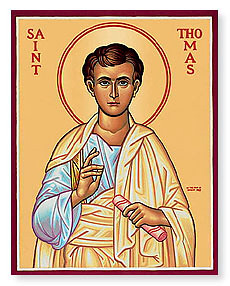
Jesus Had a Twin: Coupling Faith and Doubt During Holy Week
Jesus had a twin.
His name: Thomas.
Syrian believers knew the name alone connotated this disciple as one who was not the only one to take up residence in his mother's womb.
Greek speakers knew him by another name, "Didymus," for the same reason.
Thomas or Didymus, both mean twin.
We are not certain of the identity of Thomas' gestational roommate, but the early Gnostics had a theory. Thomas was Jesus' twin whose birth-story went untold. That's right, while innkeepers may not have been able to squeeze the Holy Family into their shelter, Mary's womb apparently had room for one more.
I guess being betrothed to a virgin carrying the Messiah was not enough of a shocker for Joseph.
It's also a minor element of the incarnation the angel left out of his Advent declaration.
Details.
I am not sure if Jesus and Thomas really were womb-mates (sorry for the parent of twins joke). Actually, as much as it would make for a great story and build on the Jacob and Esau motif within the Jewish narrative, I doubt this was Thomas' identity.
Pun intended.
Regardless of the legend, Jesus did have a twin within his cast of followers who was doubly perplexed and coupled both extradordinary faith and raw skepticism.
We are more than familiar with Thomas' hesistancy to believe in Jesus' resurrection, demanding to see evidence before trusting the Messianic mission for even one more day.
"Unless I see the mark of the nails in his hands, and put my finger in the mark of the nails, and my hand in his side, I will not believe." (John 20: 25)
We are not as familiar with Thomas' zeal and willingness to actually die with his beloved Teacher, who was about to return to hostile territory in efforts to resurrect his friend, Lazarus. You can say that before "Doubting" Thomas, there was Didymus, the purest proclamant of unfading and radical obedience.
"Let us also go; that we may die with him." (John 11:16)
This sort of bold declaration is not recorded anywhere else by any other disciple. Yet no other disciple is labeled as a doubter.
So, which is it?
Skepticism or trust?
Fear or obedience?
Doubt or faith?
Maybe they are meant to be paired together.
Maybe our spiritual gestation couples both within the womb of discipleship.
Maybe Thomas is us. Maybe we are Thomas' twin. Doubly willing and yet doubly perplexed.
As Holy Week begins, may we both confront and embrace our dual identity as believers and doubters. May we trust God's ability to work through our darkest doubts. May we give thanks for how the Spirit propels us towards faithful obedience.
May we hold on hope and believe just enough that God will once and for all reveal to us not only the resurrected Christ, but also a world made new and right.
Thomas did. That's why he went to India.
But you have to look that up for yourself.
"We often think that if we have doubt, we don’t have faith. In reality, they are inextricably tied to each other in the human experience, each one helping make the other more real. The presence of doubt doesn’t mean we’ve lost our faith. It creates the space to actually find it...Doubt and faith need each other; any faith that can't hold up to doubt isn't faith at all."
Kathy Escobar, Down We Go, pp. 138-139
------
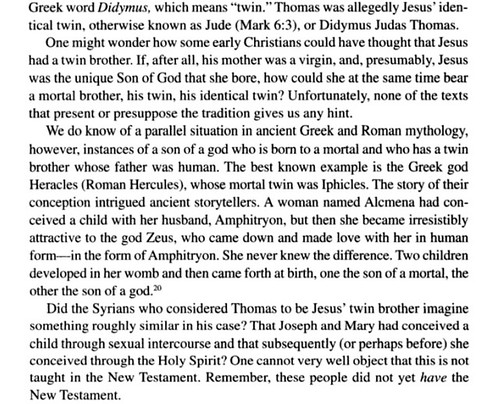
**Here is an intriguing excerpt from Bart Ehrman's, Lost Christianities. I say intriguing, but I am not sold :)
Thursday, April 3, 2014
Youth Ministry, Wild Geese, and God's Spirit as Uncaged Bird
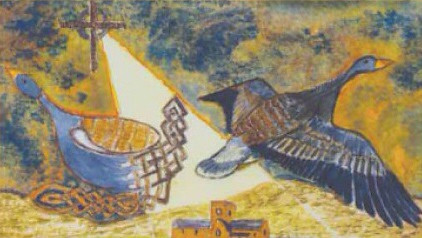
Celtic Christians have a unique image for the Holy Spirit: the wild goose.
Yep, the honking, flapping, nipping-at-your heels bird who refuses to be tamed has framed the theological imaginations of believers for generations in regions surrounding Ireland and Scotland.
The imagery is spot on and brilliant.
Like a wild goose, God nips at us and provokes us to travel to obscure places as a collection of practitioners of the kingdom unconfined by convention. God’s Spirit, like these obnoxious long-necked creatures, can even be somewhat aggravating and difficult to ignore when pushing us to defy logic and comfort. The nudging of the Divine Presence is not always graceful or welcome either, disrupting our conscience and disturbing our assumptions about what is good, right, just, and biblical.
The Holy Spirit, like our feathered friends, lives in freedom and refuses to be contained and controlled by even the most astute theologian:
"Theology must describe the dynamic interrelationships which make this procession comparable to a bird in flight, in contrast to a caged bird" (Karl Barth, Evangelical Theology)
Still more, beauty is in the flight of these strange birds. They refuse to travel alone and instead fill the skies in gaggles shaped like the letter "V." This provides yet another seemless symbol for individuals and gaggles of God's people who trust the whims of the Spirit as they follow Jesus as the head of rather rambunctious flock.
There have been books, legends, intentional communities, and music festivals developed via the inspiration of the wild goose.*
I have also adopted and extended the metaphor for the youth worker.
That's right, the wild goose is likely a teenager.
Youth frequently gather in clumps, are often dismissed as pesky and somewhat rambunctious, and adults are accustomed to head for cover whenever they see a gaggle of teenagers headed their way.
I am also pretty sure these noisy birds and middle school boys on retreat share a similar fragrance.
Wild Goose by Axe Body Spray.
Youth are also beautiful to witness in flight. Their questions nip at the heels of religious absolutes. Their desires to move to new and uncharted territories challenge settled assumptions about where the church exists in the world. The adolescent desire to take risks and listen to the sounds of their neighbors, including those frequently dismissed as distasteful, causes youth leaders to wonder where we have missed opportunities to love God as we love and give voice to others.
I have been in youth ministry for over a dacade and have had my share of crap thrown my way, another uncouth characteristic of geese. There have been moments when I have cursed under my breath God's strange and beloved creatures and questioned why God made the teenage years last for so long.
I have even pondered fleeing from the presence of youth ministry all together.
Then I watch teenagers soar. I see them spread their wings and follow the Spirit's movement in their lives. I am instantly drawn back into my vocation as though I was just beginning.
Youth ministry is hard, being an adolescent is even harder.
The Holy Spirit is difficult to comprehend, containing God's Spirit is an impossible task.
Still, whenever I follow Jesus alongside some of the youngest members of God's flock, I sense somehow the Holy Spirit is there, in the middle, drawing us closer and closer to what it means to be a part of God's dreams for the world.
Maybe that's because, like God's Spirit, youth are wild geese.
May we never try to tame them, only fly alongside them.
Notes:
*Consider the Iona Community and the book about their existence, Chasing the Wild Goose. Also, a festival I hope to attend one day, The Wild Goose Festival.
**A great interview from a friend of Westminster, who tells a story about The Wild Goose with shere brilliance: http://westminsterpc.org/filerequest/8630
***Photo above is from the cover of Chasing the Wild Goose.